Ancient → Modern
Rediscovering Rome’s Indian Odyssey
Two thousand years ago, ships from the Roman world sailed into Kerala with gold and sailed home with pepper. A Tamil love poem, a grumbling Roman and a jar of peppercorns in the Egyptian desert tell the story.
On this page
There is a Tamil poem, nearly two thousand years old, in which a man argues with his own heart.
His heart wants him to go. Out there, across the burning wasteland, there is wealth to be made, and a man with ambition should go and make it. He refuses. Even if great wealth came easily, he tells it, he will not leave her. He will not be the reason her eyes, like two blue waterlilies, fill with tears.
That is the whole poem. It is a love poem. But Tamil poets of that age liked to let a comparison run on, one thing leading to the next. Her eyes are like waterlilies from the springs of Thirupparankunram, the hill of Murugan. The hill lies west of Madurai, the city of the Pandya king. That king once laid siege to Muciri, the rich port of the Chera. And of Muciri, in a few passing lines, the poet records one of the greatest trades of the ancient world.
Gold in, pepper out
cuḷḷiyam pēriyāṟṟu veṇ nurai kalaṅka
yavanar tanta viṉai māṇ naṉkalam
poṉṉoṭu vantu kaṟiyoṭu peyarum
vaḷam keḻu muciṟi
Where the fine, well-made ships of the Yavanas churn the white foam of the great river Periyar, come in with gold, and go back with pepper: Muciri, rich and thriving.
Akananuru 149
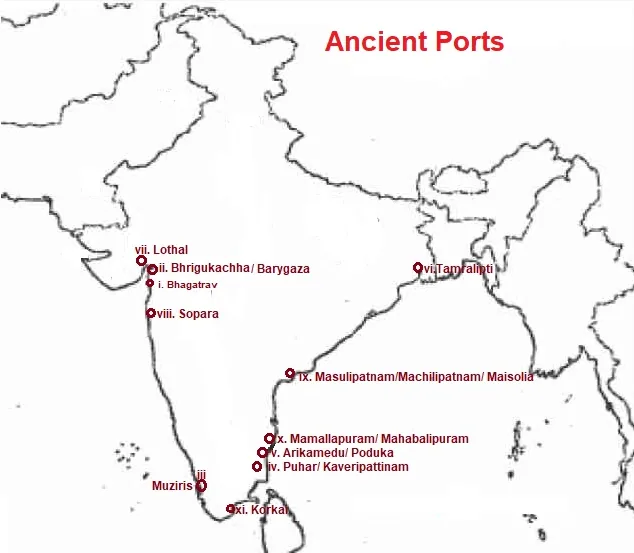
The Yavanas were what the Tamils called the people who came from the west: Greeks, Egyptians, Romans. Muciri was Muziris, the great port of the Chera kings, near where the Periyar meets the sea in Kerala. And the trade was as simple as the poem makes it sound. They came with gold. They left with pepper.
I love that this line survives inside a poem about a man who will not go after money. The biggest commercial venture of its age is a detail in the background, a link in a chain of praise for a woman’s eyes. In the foreground is a man who has decided that some things are worth more than gold.
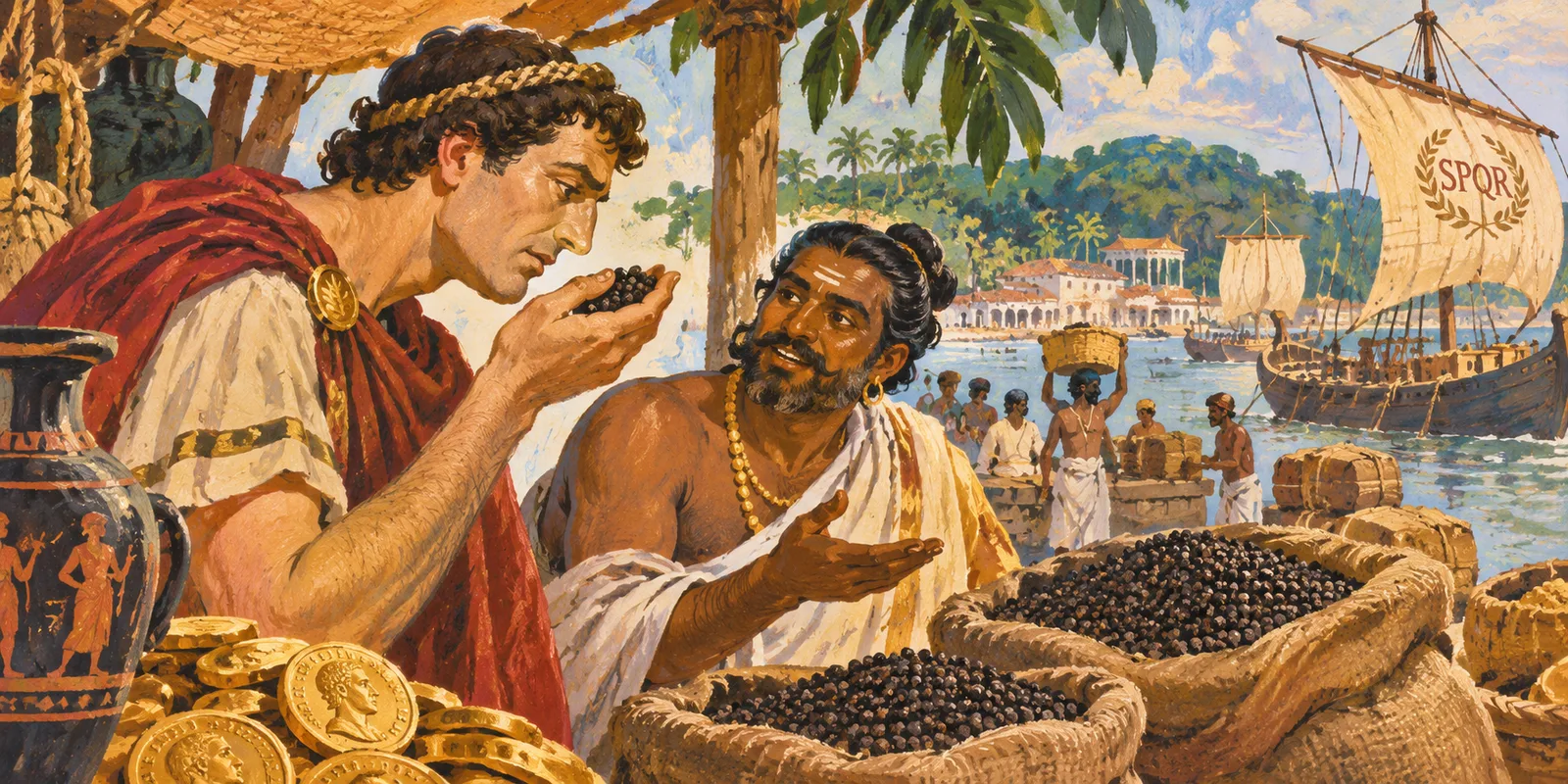
They buy it by weight, like gold
On the other side of the world, a Roman could not understand it.
Pliny the Elder, writing his great Natural History in the first century, stops in the middle of his chapter on pepper to complain.
It is quite surprising that the use of pepper has come so much into fashion, seeing that in other substances which we use, it is sometimes their sweetness, and sometimes their appearance that has attracted our notice; whereas, pepper has nothing in it that can plead as a recommendation to either fruit or berry, its only desirable quality being a certain pungency; and yet it is for this that we import it all the way from India!
Pliny, Natural History 12.14
He wonders who was the first person to try it as food. He notes, a little bitterly, that pepper and ginger grow wild in their own countries, “and yet here we buy them by weight, just as if they were so much gold or silver.” He even gives the prices: fifteen denarii a pound for long pepper, seven for white, four for black.
A few chapters later he adds up the cost. India, China and Arabia together, he says, “withdraw from our empire one hundred millions of sesterces every year.”
You can hear the grumble in it. Every generation has someone who looks at what young people are spending on and shakes his head. But Pliny was not wrong about the gold. It really was leaving Rome. It was going to Muciri.
A great quantity of coin
How it got there is written down in a merchant’s handbook, the Periplus of the Erythraean Sea: a Greek guide, written by someone who had made the voyage, to the ports of the Red Sea and the Indian Ocean.
When it reaches Muziris, the author tells you exactly what to expect. The ships that go there are large, “on account of the great quantity and bulk of pepper and malabathrum.” And what should you bring to trade? “In the first place, a great quantity of coin.” What will you take home? “Pepper, which is produced in quantity in only one region near these markets.”
It is the same sentence as the Tamil poem, from the other side of the sea. Gold in, pepper out.
Pliny tells us how long the voyage took. With the monsoon wind behind them, ships could cross from the mouth of the Red Sea to Muziris in forty days. The big ships could not come close to the shore there, so their cargo was ferried in and out on smaller boats: up the river, perhaps, where the poet saw the white foam churning.
And one of those cargoes has survived on paper. A papyrus now in Vienna, known as the Muziris papyrus, is a loan contract for a single voyage from Alexandria to Muziris and back. On its other side is a valuation of the cargo carried home by one ship, the Hermapollon: pepper, Gangetic nard, ivory and fine cloth. The cargo of that one ship was worth millions of sesterces, and the empire took a quarter of it in customs duty as it came in. Rome grumbled about the gold that left, but it did very well out of the pepper that arrived.
Roman gold coins still turn up in hoards across south India today. They are the other half of that bargain.
Fine vessels and fierce guards
The Yavanas did not only come and go. Some of them stayed, and the Tamil poets noticed them.
In one poem the poet Nakkeeranar compares a Pandya king to Shiva, Balarama, Vishnu and Murugan, and then wishes him a long and sweet life, giving away jewels to all who come to him in need, while women with bright bangles pour him wine:
yavaṉar naṉkalam tanta taṇ kamaḻ tēṟal
poṉ cey puṉai kalattu ēnti
Cool, fragrant wine that the Yavanas brought in their fine vessels, poured from golden pitchers.
Purananuru 56
In another, a king is away at war, camped in the field. The poet walks us through the camp at night, and in the king’s own quarters, lit by bright lamps, we meet his guards:
Harsh Yavanas, fierce to look at, their strong bodies in tight shirts girdled with horse reins.
Mullaippattu 59 to 61
So there were men from the Mediterranean standing guard over a Tamil king while he slept. In a third poem, a palace is lit by lamps held up in the hands of figures that Yavana craftsmen had made. The foreigners were in the wine cups, at the tent doors, in the lamplight. They had become part of the furniture of Tamil life.
A jar of pepper in the desert
The ships from India did not sail into Italy. They landed on the Egyptian coast of the Red Sea, at ports like Berenike, and from there the cargo went across the desert by camel to the Nile, and down the Nile to Alexandria.
In 1999, archaeologists digging at Berenike found a large storage jar set into the floor of the courtyard of the temple of Serapis. Inside it were 7.55 kilograms of black peppercorns from south India, from the first century. It is the largest store of black pepper ever found anywhere in the classical Mediterranean world, and it was not in a warehouse. It was in a temple, kept for the god.
The same sand at Berenike has given up a Buddha statue and an inscription in Sanskrit, which I wrote about in Sanskrit in the Sahara. But it is the peppercorns that move me most. Somebody, two thousand years ago, filled that jar with pepper picked from vines in Kerala, and carried it across an ocean and a desert to offer it to a god.
Three thousand pounds of pepper
The trade outlived the empire’s best days. In 408, more than three hundred years after Pliny’s grumbling, Alaric and his Goths had Rome under siege, and the starving city sent envoys to ask what it would cost to make him leave. The historian Zosimus records the price.
It was at length agreed, that the city should give five thousand pounds of gold, and thirty thousand of silver, four thousand silk robes, three thousand scarlet fleeces, and three thousand pounds of pepper.
Zosimus, New History 5.41
Gold, silver, silk, and pepper. At the end of everything, when Rome had to buy its own life, the little black seed from Kerala was still on the list of treasures.
The little black seed
Today pepper is the cheapest thing on the table. It sits beside the salt in every restaurant, and nobody thinks of it as treasure. The vines still climb the trees in Kerala, and the berries still dry in the sun to the same wrinkled black.
What I find hopeful in this story is how ordinary its threads are. Two great civilisations were connected not by emperors or armies, but by an appetite for a taste. By sailors who learnt the monsoon. By a merchant who wrote down what to bring. By a guard far from home at a Tamil king’s tent. By someone who filled a temple jar. The world was joined together long before we called it globalisation, and it was joined by small, everyday things.
And in the middle of it all is that man in the Tamil poem, the one who would not go. The ships came and went at Muciri, loaded with the wealth of the world, and he chose to stay home with her. Of everyone in this story, he may have understood best what was really worth the most.
That’s my musing for the day. The next time you grind pepper over your food, remember that it was once worth its weight in gold, and that a poet once found something worth more.
References
- Akananuru 149 (Erukkattur Thayankannanar), with translation, Sangam Poems Translated by Vaidehi. The man who will not go, and the Yavana ships at Muciri.
- Mullaippattu 59 to 63, with translation, Sangam Poems Translated by Vaidehi. The Yavana guards in the king’s camp. The lamps held by Yavana-made figures are in Nedunalvadai 101 and 102.
- Purananuru 56 (Nakkeeranar, to the Pandya king Nanmaran), with translation, Sangam Poems Translated by Vaidehi. The Yavanas’ cool, fragrant wine.
- Pliny the Elder, The Natural History, translated by John Bostock and H. T. Riley (1855): 6.26 for the voyage of forty days to Muziris, 12.14 for pepper and its prices, and 12.41 for the hundred million sesterces.
- The Periplus of the Erythraean Sea, translated by Wilfred H. Schoff (1912), sections 54 and 56. Muziris, its large ships, the coin brought in and the pepper taken out.
- The Muziris papyrus, P. Vindob. G 40822, Austrian National Library, Vienna. On the Hermapollon and its cargo, see Federico De Romanis, The Indo-Roman Pepper Trade and the Muziris Papyrus (Oxford University Press, 2020).
- Steven E. Sidebotham, Berenike and the Ancient Maritime Spice Route (University of California Press, 2011). The jar of black peppercorns in the courtyard of the temple of Serapis.
- Zosimus, New History, Book 5 (translation of 1814), chapter 41. The ransom of Rome in 408.