Technology & Society
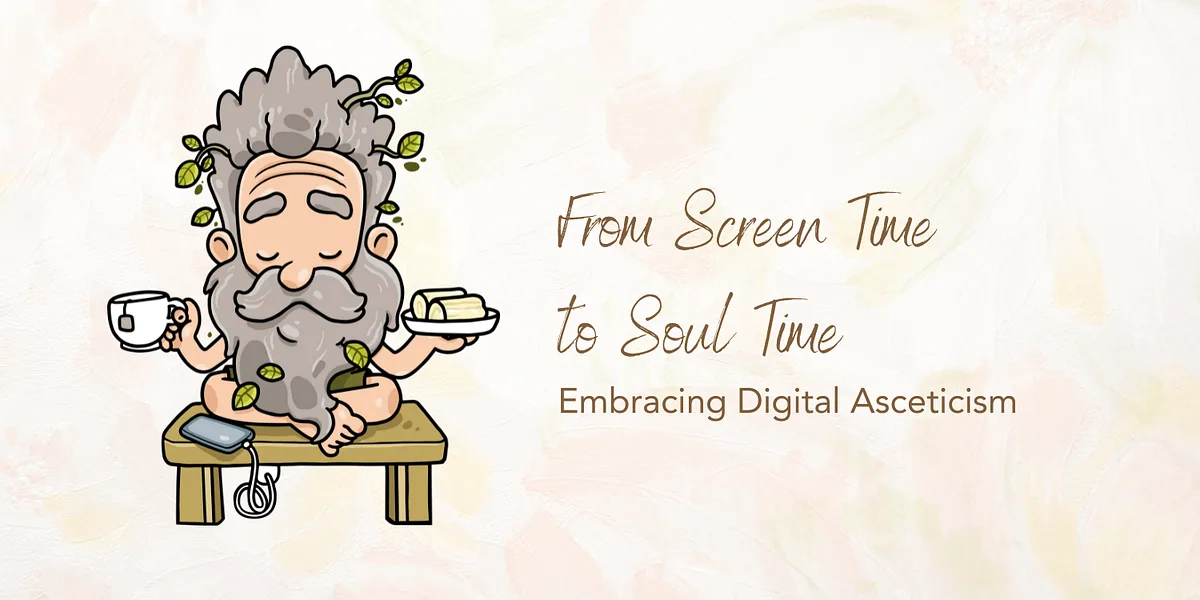
From Screen Time to Soul Time
In the chaotic noise of emails, push notifications, endless scrolling, and incessant multitasking, many of us are seeking solace and meaning.
On this page
- What is Asceticism in Indian Philosophy?
- The Modern Dilemma: Information Overload
- Digital Asceticism: The Concept
- The Philosophical Base: The Middle Way
- Intentionality: The Core Principle
- Mindfulness: The Operational Mechanism
- Detachment and Attachment: A Dual Process
- Sustainable Practices: The Long Game
- Practical Steps to Adopt Digital Asceticism
- Screen Fasting (Vratas)
- Single-Tasking (Ekagrata)
- Purposeful Consumption (Ahara)
- Digital Sabbatical (Anushthana)
In the chaotic noise of emails, push notifications, endless scrolling, and incessant multitasking, many of us are seeking solace and meaning. Interestingly, the wisdom to navigate this digital chaos might lie in an ancient lifestyle, the way of the ascetic. In Indian philosophy, the ascetic or “Sanyasi” chooses a life of minimalism, distancing themselves from worldly distractions to focus on spiritual growth. As we grapple with a digital environment that incessantly demands our attention, could we adapt the principles of asceticism to practice a form of “Digital Asceticism”? This post aims to explore this intriguing possibility.
What is Asceticism in Indian Philosophy?
Asceticism in Indian philosophy is not just an external practice of renunciation but a profound internal journey aimed at attaining spiritual liberation, or “Moksha.” Rooted deeply in philosophies like Vedanta, Sankhya, and various schools of Yoga, the lifestyle of an ascetic or “Sanyasi” is intricately designed to reduce and eventually eliminate all forms of external dependencies.
In the classical Indian tradition, life is divided into four stages or “Ashramas”: Brahmacharya (student life), Grihastha (household life), Vanaprastha (retirement), and finally Sanyas (renunciation). Sanyas is considered the pinnacle where one renounces material possessions, familial ties, and even one’s name to focus solely on spiritual growth. The philosophy is that by detaching oneself from the transient world, one can gain a clearer understanding of the eternal self or “Atman.”
Various practices accompany this ascetic lifestyle:
- Tapas (Austerities): The Sanyasi practices physical and mental austerities to master self-discipline. This could range from simple fasting to intense practices like standing on one leg for extended periods.
- **Svadhyaya (Self-Study):**Daily reading of spiritual texts and scriptures helps in introspection and understanding one’s role in the grand scheme of existence.
- Samadhi (Meditation): Deep states of meditation allow the ascetic to transcend ordinary consciousness and experience unity with the divine.
- **Ahimsa (Non-violence):**A core tenet, not just in actions but also in thoughts and words. The purpose is to cultivate a sense of universal compassion.
By living a life that is divested of distractions and superficial engagements, the ascetic aims to delve into the very core of human existence, posing questions that go beyond the everyday concerns of life.
The Modern Dilemma: Information Overload
We live in an age of unprecedented access to information. Digital platforms, email, social media, and instant messaging have revolutionized the way we consume and interact with data. While this phenomenon has enormous benefits, such as democratizing information and breaking down geographical barriers, it also comes with a set of unique challenges that have profound implications on our mental well-being and cognitive functions.
- Cognitive Overload: The human brain has a limited capacity for processing information. Constant exposure to new information can saturate our cognitive abilities, leading to reduced comprehension and decision-making skills.
- FOMO (Fear of Missing Out): The sheer volume of content available can instigate a fear of missing out on important news, trends, or social interactions. This compels us to remain perpetually connected, further contributing to mental exhaustion.
- Reduced Quality of Interactions: The convenience of digital communication often comes at the expense of deeper, more meaningful human interactions. The quick exchange of messages can never replace the emotional richness of face-to-face conversations.
- **Paradox of Choice:**Abundance of choice, while empowering, can also be crippling. The multitude of apps, websites, and platforms often leads to what psychologists call the “paradox of choice,” where more options lead to less satisfaction.
- **Digital Dependency:**Over time, the continuous engagement with digital platforms can lead to dependency, manifesting symptoms similar to substance addiction such as withdrawal, tolerance, and relapse.
The existential philosopher Søren Kierkegaard once said, “Life can only be understood backward, but it must be lived forwards.” In the context of our digital lives, the sentiment rings true. We find ourselves in a labyrinth of digital chaos, sometimes failing to realize how we got here and struggling to find a way out. It is as if we have opened Pandora’s box, and now face the task of making sense of its overwhelming contents.
Digital Asceticism: The Concept
The idea of Digital Asceticism draws its philosophical underpinning from the ancient practices of asceticism, but it’s tailored for the modern world saturated with digital stimuli. It’s a reconceptualization that moves away from the idea that the digital world is inherently detrimental. Rather, it argues that our engagement with this world can be made more mindful, purposeful, and ultimately, more fulfilling.
The Philosophical Base: The Middle Way
The concept of Digital Asceticism does not advocate for an outright rejection of technology. This is akin to the “Middle Way”, which suggests a balanced approach between extreme asceticism and worldly indulgence. The idea is not to renounce, but to regulate.
Intentionality: The Core Principle
At the heart of Digital Asceticism lies the principle of ‘intentionality’. Just as an ascetic is highly intentional about every action, right down to each breath taken, the digital ascetic becomes intentional about every click, swipe, and tap. This brings a level of awareness that transforms otherwise mindless interactions into meaningful engagements.
Mindfulness: The Operational Mechanism
Digital Asceticism employs mindfulness as its primary operational mechanism. This involves constantly questioning our actions and decisions in the digital space. Why am I checking my phone? Is this scroll through social media adding value to my life? These questions serve as checkpoints that help recalibrate our digital behavior.
Detachment and Attachment: A Dual Process
In traditional ascetic practices, detachment from worldly concerns is a crucial aspect. In Digital Asceticism, detachment serves a dual purpose, detaching from unmeaningful digital engagements and re-attaching to what truly matters, be it focused work, meaningful conversations, or self-care.
Sustainable Practices: The Long Game
The ascetic life is not about short-lived intensity but sustainable practices that compound over time to yield spiritual insight. Similarly, Digital Asceticism focuses on sustainable digital habits (be it a regulated use of social media, periodic digital detox, or adopting technology that aligns with one’s values) that collectively build a fulfilling digital life over time.
Digital Asceticism is not just a lifestyle choice but a philosophical stance, a redefinition of how we interact with the modern world. By consciously curating our digital lives based on the principles of asceticism, we can aim to find a harmonious balance in the cacophonous digital age.
Practical Steps to Adopt Digital Asceticism
The transformative power of any philosophical concept lies in its applicability. Just as ancient ascetics had their rituals and disciplines, modern-day digital ascetics need practical guidelines. Here are some methods, each with its roots in traditional ascetic practices, to integrate digital asceticism into your life:
Screen Fasting (Vratas)
- **Time Boundaries:**Ascetics often adopt fasting as a means to practice self-control. You can emulate this by designating specific time intervals during the day where you refrain from screen use. This not only reduces cognitive load but also helps in establishing digital boundaries.
- Type Limiting: Limiting the type of content you consume can be equally powerful. A specific fast from social media or news websites can be scheduled weekly to disconnect and refresh your mind.
Single-Tasking (Ekagrata)
- Deep Work Sessions: The ascetic practice of deep meditation resembles the modern concept of ‘Deep Work’. Allocate specific blocks of time for focused work and eliminate all digital distractions during this period.
- **Digital Satsang:**Make time for meaningful digital interactions, like a virtual book club or professional seminars, that enhance your skills and well-being. It aligns with the ascetic practice of ‘Satsang,’ a gathering for the pursuit of higher truths.
Purposeful Consumption (Ahara)
- Curated Information Diet: Ascetics are selective about what they consume, including information. Adopt a similar approach to your digital consumption. Utilize platforms and tools that allow you to filter out unwanted noise and focus on relevant, uplifting content.
- **Minimalist Digital Environment:**Remove redundant apps and bookmarks. Declutter your digital workspace to contain only essential tools and information, emulating the minimalist environment an ascetic would surround themselves with.
Digital Sabbatical (Anushthana)
- Periodic Disconnect: Just as ascetics go on spiritual retreats to rejuvenate, scheduling a periodic digital sabbatical can work wonders for your mental health. It provides a reset button for your cognitive functions and lets you evaluate your digital dependencies.
- **Tech-Free Zones:**Create specific spaces in your home where digital devices are not allowed. These can serve as your mini-retreats for mental peace, similar to the secluded spots chosen by ascetics for meditation.
Each of these practices serves a particular purpose and addresses a different aspect of our digital lives. Importantly, these are not strict rules but flexible guidelines that you can adapt based on your lifestyle and needs.
That’s my musing for today.