Ancient → Modern
Beyond the Battlefield: Unraveling the True Genghis Khan
The Mongols' own book about Genghis Khan keeps a murdered brother, a lost battle and a boy afraid of dogs. It also keeps the massacres, and the rule that explains both.
On this page
I first met Genghis Khan in Telugu, in Tenneti Suri’s novel Chengiz Khan. Most of us meet him in one of two other books. In the first he is the scourge: the horseman who burned cities from China to Persia and left pyramids of skulls behind him. In the second, which is newer and sells well in airports, he is a visionary: the founder of meritocracy, religious tolerance and the postal service, a man with lessons for every chief executive.
Both are legends. The first was written mostly by the people he conquered. The second was written by people who wanted him to be useful. The account that comes closest to the man was written by neither. It was written by his own people, within living memory of him, and it is stranger and more honest than either legend.
The book the Mongols kept
It is called the Secret History of the Mongols, and it was completed in 1228, a year after his death, when the Mongol princes gathered to choose his successor. The quotations here are from Igor de Rachewiltz’s translation.¹
It was written by insiders, for insiders, at a moment when the dynasty needed its story told. What makes it remarkable is what it keeps anyway. A court biography would cut the scenes in which its hero is frightened, humiliated, defeated or cruel to his own family. The Secret History keeps all of them.
A boy who was afraid of dogs
Temüjin was born around 1162 on the Onon River in what is now northern Mongolia. He came into the world clutching in his right hand “a clot of blood the size of a knucklebone.” His father, Yisügei, had just captured a Tatar chief called Temüjin Üge, and named his son after the prisoner.
When the boy was nine, Yisügei rode out to find him a wife. On the way he met Dei Sechen of the Onggirat, who had a daughter called Börte, a year older than Temüjin. The book says Yisügei saw in her a girl “who had light in her face, who had fire in her eyes,” the same words used for Temüjin himself. The families agreed, and by custom the boy stayed behind with his future in-laws. As he left, his father made one request of Dei Sechen: “my son is afraid of dogs. Quda, don’t let him be frightened by dogs!”
It is the first thing the Mongols chose to remember about their founder’s character, and it is not courage.
On the ride home, Yisügei stopped at a Tatar feast. They recognised him, remembered his raids, and poisoned his food. He reached his tent three days later and died. In the spring that followed, the widows of an earlier khan held the sacrifice to the ancestors and left Temüjin’s mother, Hö’elün, out of the meal. When she protested, they told the clan to move on without her. An old retainer who tried to stop them was speared in the back. Temüjin went to see him, and “wept and went out.”
Hö’elün took up the clan standard and rode after the departing people alone. She brought back half of them. They left again anyway.
What followed is told as a kind of hymn. Abandoned on the steppe with seven children, she gathered crab apples and bird cherries along the Onon and dug for roots with a stick of spruce. Her sons learned to bend needles into hooks, and fished for her.
The fish
One day Temüjin and his full brother Qasar caught a fish, and their half-brothers Bekter and Belgütei took it from them. They had done the same with a lark a few days earlier. The boys complained to their mother, and Hö’elün’s answer has become the most quoted line in the book:
We have no friend but our shadow,
We have no whip but our horse’s tail.
Hö’elün to her sons, in the Secret History of the Mongols
She reminded them of Alan Qo’a, the ancestress of their clan, who had once given each of her five sons a single arrow to break, and then a bundle of five that none of them could break.
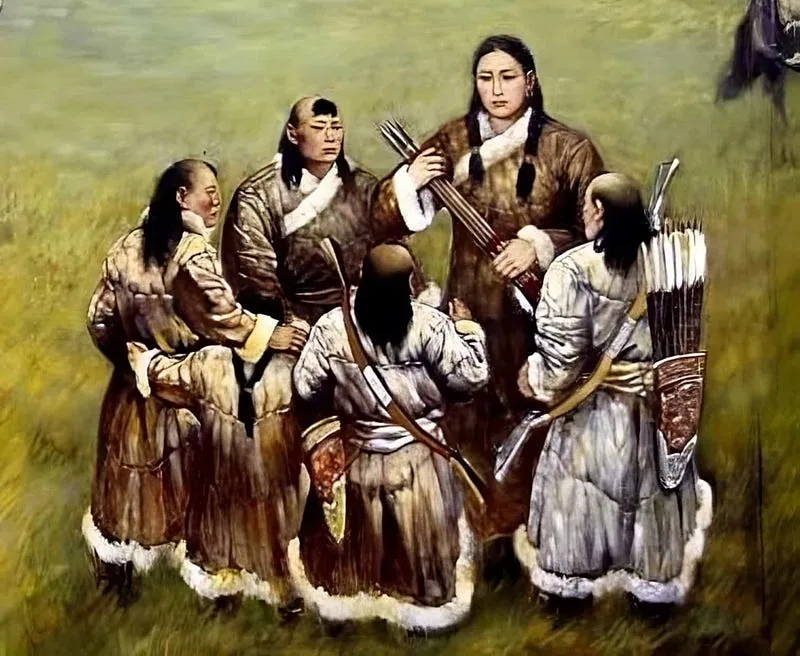
Temüjin and Qasar did not listen. They went out, found Bekter sitting on a hillock watching the horses, and crept up on him from front and back. Bekter saw them coming. He asked them only to spare his younger brother Belgütei, then sat down cross-legged and waited. They shot him at close range.
When they came home, their mother knew at once. “You who have destroyed life!” she said, and compared her eldest son to a dog snapping at its own afterbirth, a camel biting its foal’s heel, a duck eating its own chicks.
The legend-makers on both sides tend to skip this scene: one because it is too small, the other because it is too ugly. The Secret History, written for Temüjin’s own descendants, keeps it, and keeps the mother’s verdict. Belgütei, the brother Bekter died asking them to spare, rode beside Temüjin for the rest of the story.
The strangers who didn’t hand him over
The clan that had abandoned the family came back for the eldest son. Temüjin hid in a thicket for nine days without food before hunger drove him out, and they caught him. He was locked in a cangue, a heavy wooden collar, and passed from tent to tent.
On the night of a summer feast he knocked down the young man guarding him and ran. He lay down in the river, letting the wooden collar float on the current, with only his face above the water. In the moonlight a man named Sorqan Shira, who served his captors, saw him there. He did not raise the alarm. He told Temüjin to lie still, steered the search party elsewhere, and walked on.
Temüjin did not go home. A few nights earlier, when he was being passed from tent to tent, Sorqan Shira’s two sons had quietly taken off his cangue so that he could sleep. So he went looking for their tent, and found it in the dark by the sound of mare’s milk being churned through the night. Sorqan Shira was alarmed to see him. His sons were not. They smashed the cangue, burned it, and hid him in a cart of wool behind the tent, with their younger sister told to say nothing. When the searchers came and began pulling at the wool, Sorqan Shira said: “in such heat, how could one stand it amidst the wool?” Then he gave the boy a mare, a cooked lamb, milk, a bow and two arrows, and sent him home. He gave him no saddle and no flint.
Not long afterwards, thieves stole the family’s eight horses. Temüjin tracked them for three days and met a boy milking mares, who left his pail in the grass and rode with him. “Men’s troubles are the same for all,” the boy said. His name was Bo’orchu. When they had won the horses back, Temüjin offered to share them, and Bo’orchu refused: he had come because a friend was in trouble, not for booty.
By the time he was a young man, Temüjin owed his life to people who had no reason to help him, and his own kin had twice abandoned him. Everything he built afterwards makes more sense if you keep that in mind.
Two sworn brothers
His closest friend was Jamuqa. At eleven they became anda, sworn brothers, in the way boys on the steppe did it: Jamuqa gave Temüjin a roe-deer knucklebone, Temüjin gave Jamuqa one cast in copper, and they played knucklebones together on the frozen Onon. The next spring they swore again, exchanging arrowheads.
Years later, Merkit raiders carried off Börte. Temüjin got her back with the help of two allies: Jamuqa, and Ong Khan of the Kereyit, his father’s own sworn brother. After the rescue, he and Jamuqa renewed the oath a third time. They girded each other with golden belts taken from the defeated Merkit chiefs, feasted, and slept under one blanket.
It lasted a year and a half. Then, as the two camps were moving together, Jamuqa said something Temüjin could not interpret. Let us camp near the mountain, he said, and there will be shelter for our horse-herders; let us camp near the river, and there will be food for our shepherds. Temüjin rode back to ask his mother what it meant. Before she could answer, Börte did. Jamuqa grows tired of his friends, she said, and these words are aimed at us. They broke away from his camp that night.
The war between the sworn brothers was not the glorious partnership of later retellings. Temüjin lost the first real battle of it. At Dalan Baljut, Jamuqa’s coalition drove him into a gorge by the Onon. What turned the defeat into a victory was what Jamuqa did next: on his way home he boiled captive princes alive in seventy cauldrons. Several clans left him and came over to Temüjin.
The rule
There is one judgment that the Secret History records Temüjin making again and again, and it explains more about him than any battle.
After he defeated the Tayichi’ud, the clan that had abandoned his family, he asked the men who had come over to him which of them had shot his war horse out from under him. One of them stepped forward and said he had, and that if he were spared he would charge for the khan through deep water and shining stone. Temüjin said that a former enemy usually hides what he has done, and this one did not: “He is a man to have as a companion.” He renamed him Jebe, which means a kind of arrow. Jebe became one of the great generals of the age.
Later, an old man and his two sons captured the Tayichi’ud chief who had once held Temüjin in the cangue. On the way to deliver him, one of the sons stopped them: if they arrived having laid hands on their own lord, why would the khan ever trust them? They let their prisoner go and came empty-handed. Temüjin told them they had done right. If they had brought their lord in, he said, they and their families would have been cut down.
And at the end, in 1205, Jamuqa’s last five companions seized him and handed him over. Temüjin had the five executed in front of him: “How could we let men live who have raised their hands against their rightful lord?” Then he offered Jamuqa his friendship again. Jamuqa refused. “When it was the time for being companions, I was not one,” he said, and if he were spared he would only be “a louse in your collar, a thorn in the inner lapel of your coat.” He asked to die without his blood being shed. Temüjin, calling him “a man of high standing,” granted it, and had him buried with honour.
The pattern is consistent. Loyalty to your lord was the highest virtue, even when your lord was Temüjin’s enemy, because a man who would betray his lord would one day betray you. A boy who had been abandoned by his own clan and saved by strangers grew up to build a political order on that rule.
What 1206 built
In the Year of the Tiger, 1206, the peoples of the felt tents gathered at the source of the Onon, raised a white standard with nine tails, and proclaimed him Chinggis Khan. The book then lists the ninety-five men he made commanders of a thousand.
It is worth reading the list slowly, because it is where the airport-book claim about meritocracy is half right. Bo’orchu, the boy with the milk pail, is there. So is Jelme, the son of a smith. So is Sorqan Shira, who hid him in the wool cart, and Jebe, who shot his horse, and the son who argued that a lord should not be betrayed. Some of the thousands were also given to sons-in-law who led their own peoples, so marriage and alliance still mattered. But a great part of the new army was commanded by men chosen for their service, not their birth.
Four names on the list belong to children his mother had raised. Four times, after the Mongols sacked an enemy camp, someone brought Hö’elün a little boy left behind there: one from the Merkit, who had stolen Börte; one from the Tayichi’ud, who had abandoned her; one from the Jürkin; and one from the Tatars, who had poisoned her husband. That last one wore a gold ring in his nose and a silk waistcoat lined with sable. She raised all four in her own tent, saying they would be “eyes, for my sons to see in the day, ears, for my sons to hear at night.”
The Tatar boy was Shigi Qutuqu. In 1206, Chinggis made him supreme judge, charged with “curbing theft, discouraging falsehood,” and ordered him to write every judgment and distribution of people in a register in blue script, so that no one could alter it afterwards. The child found in the camp of his family’s worst enemies became the keeper of the empire’s law.
This blue register, not the famous Yasa, is what the Secret History actually describes. The idea of a single great law code issued by Chinggis rests mainly on later Persian writers. No copy has ever been found, and it may never have existed as one written book. What existed was a body of decrees, and a judge who kept them.²
What the book does not soften
It would be easy to stop there and write the airport version. The Secret History does not let you.
When Chinggis finally destroyed the Tatars, his council decided to “measure the Tatars against the linchpin of a cart”: every male taller than a cart’s axle pin was to be killed, and the rest enslaved. When the Khwarazmian empire in Central Asia killed a hundred of his envoys, he took his armies west in 1219, and the cities of Bukhara, Samarkand and Merv were sacked in the years that followed. And near the end of his life, after the destruction of the Tangut kingdom, the book records an order he gave: “While I take my meals you must talk about the killing and destruction of the Tang’ut and say, ‘Maimed and tamed, they are no more.’” He died that year, in 1227.
The same book that remembers the boy afraid of dogs remembers this, without apology.
I don’t think the two halves contradict each other. They are the same rule seen from both sides. Inside the bond of loyalty, Chinggis was generous to a degree that astonished his contemporaries: he spared archers who had shot at him, raised his enemies’ children as brothers, and made a foundling his chief judge. Outside it, there was no limit at all. A people who broke their word to him, or killed his envoys, had put themselves outside the only moral world he recognised.
Beyond the battlefield
So who was Genghis Khan beyond the battlefield? The Secret History does not give us a better man than the legends. It gives us a more legible one.
He was a frightened child whose clan left his family to starve, and who killed his own brother over a fish. He was saved by strangers, betrayed by his closest friend, and defeated before he ever won. Out of that he made an order in which abandonment was the unforgivable crime, and inside which a boy from any camp could rise. And he turned that order, with complete conviction, on everyone who stood outside it.
Hö’elün’s line about the shadow and the horse’s tail was a warning to her sons that they had no one but each other. Her eldest son spent his life making sure he would never be that alone again. The empire he left behind was the size of that fear.
References
- The Secret History of the Mongols: A Mongolian Epic Chronicle of the Thirteenth Century, translated by Igor de Rachewiltz, shorter version edited by John C. Street (Western Washington University, 2015). The episodes are in §59 to §78 (birth, betrothal, Yisügei’s death, the abandonment, Bekter), §79 to §93 (the cangue, Sorqan Shira, Bo’orchu), §116 to §118 (the oaths with Jamuqa and the parting), §129 (Dalan Baljut), §135 to §138 (Hö’elün’s foundlings), §147 to §149 (Jebe, and the release of Tarqutai), §154 (the Tatars), §200 to §203 (Jamuqa’s death, the assembly of 1206, Shigi Qutuqu), §254 and §268 (the envoys, and the Tangut).
- “Yasa”, Encyclopaedia Iranica. Whether a written Great Yasa ever existed.