Human Quest
Heroes & Humanity in Seven Samurai
Kurosawa's film is named after its seven swordsmen, but its last word goes to the farmers who hired them. A look at the people on both sides of that line, and the one man who stood on it.
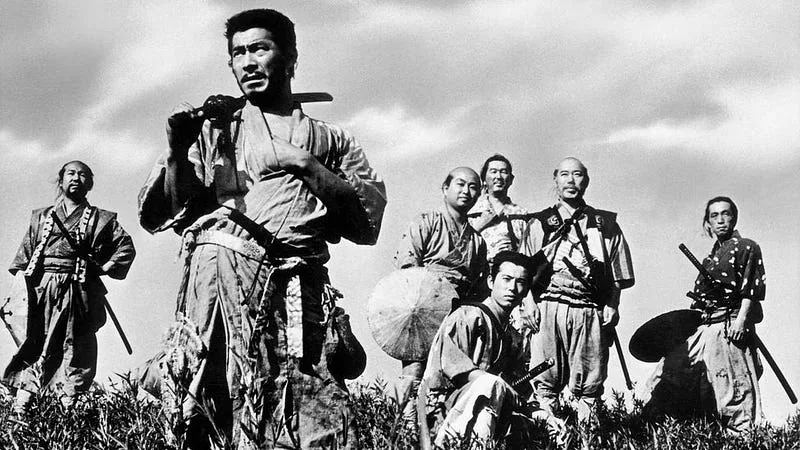
Seven Samurai ends on a hillside with four mounds of earth, a sword planted in each. Below them, the village is planting rice. The farmers sing as they work, to the beat of a drum, and the three samurai who survived stand and watch. Kambei, their leader, says the line the whole film has been walking towards:
In the end, we lost this battle too. … I mean, the victory belongs to those peasants. Not to us.
Kambei, Seven Samurai
The film is named after its seven swordsmen, and it gives them some of the greatest entrances in cinema. But it gives the last word to the farmers. Kurosawa’s story is about heroes, and it is also about the line between the men with swords and the people who grow the rice, and about the one man who stood on that line.
Find hungry samurai
It begins with a village that has no way out. Bandits will be back when the barley is ripe, and they will take everything. The villagers argue between giving in and fighting until the old man of the village settles it. Hire samurai, he says, and when they protest that no samurai will fight for farmers in return for food, he has an answer:
Find hungry samurai.
The old man, Seven Samurai
So four farmers go to town with a sack of rice, which is all they can pay, and live on millet themselves to save it. They are mocked and turned away until a labourer at their lodging holds up a bowl to the samurai in the room. This is your dinner, he says; the farmers eat millet to feed you white rice. Kambei Shimada takes the bowl. “I won’t let this rice go to waste.”
Kambei
We have already met him by then. A thief has taken a child hostage in a barn, and a grey-haired samurai sits while a monk shaves his head. He borrows the monk’s robe, asks the villagers for two rice balls, and walks up to the barn as a holy man bringing food. The child comes out alive.
For a samurai, the topknot was a mark of rank, and Kambei gives it up without a word to save a farmer’s child. That is the whole man, and Takashi Shimura plays him with a stillness that makes everyone around him look restless. He is a fine strategist who describes himself, without self-pity, as a man who has seen his share of battle, “but always on the losing side.”
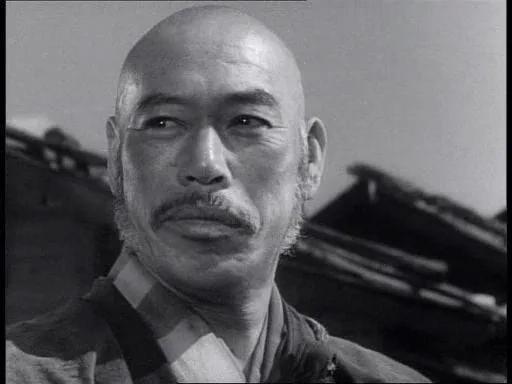
He chooses his men for their character, and the men who join him join for his. Gorobei, the first, tells him plainly that he has not signed up for the farmers’ sake: “it’s your character that I find most compelling.”
Six more
Each of the others gets only a few scenes to become a person, and each does.
Gorobei is cheerful and shrewd, a good archer and a better judge of men. He finds the next recruit himself.
Heihachi is that recruit, a samurai of modest skill found chopping wood to pay for a meal. Gorobei explains why he chose him anyway: “He’ll be a treasure in hard times.” Heihachi makes the village a flag, with six circles for the samurai, a triangle for Kikuchiyo and a symbol for the farmers below. He is the first of them to die.
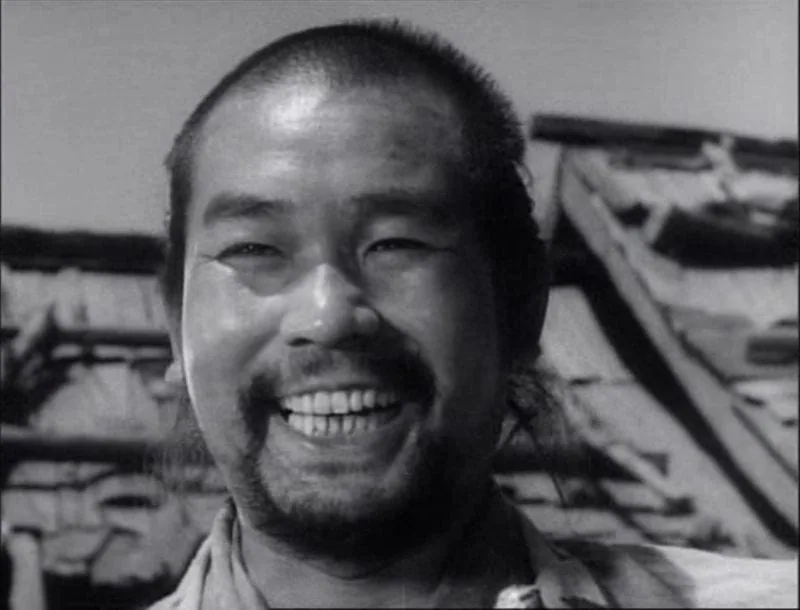
Shichiroji is Kambei’s old lieutenant. They last saw each other in a castle that fell, and Shichiroji survived by hiding in the moat until dark. When Kambei asks him to follow him into another losing fight, he simply agrees. Their friendship needs no scene to explain it.
Kyuzo is the master swordsman. We first see him in a duel with wooden swords; his opponent claims a draw, insists on steel, and dies. Kyuzo turns Kambei down at first, then appears later to join without a speech. One night he goes out alone towards the bandits, comes back at dawn with one of their muskets, says barely a word about it, and goes to sleep.
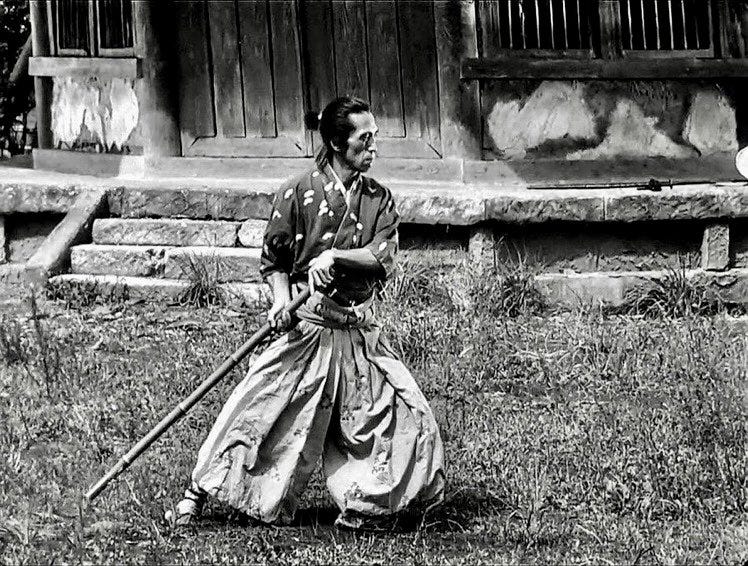
Katsushiro is the boy of a good family who begs Kambei to take him as a disciple. He worships Kyuzo, falls in love with a farmer’s daughter, and is the one of the seven who learns the most and understands the least, which is what being young is.
And then there is the seventh.
Kikuchiyo
Kikuchiyo arrives drunk, carrying a sword too long for him and a family scroll he has stolen. Kambei reads it aloud: by the date on it, the Kikuchiyo it records would be thirteen years old. The others laugh him out of the room, and he follows them all the way to the village anyway. Toshiro Mifune plays him like a stray dog that has decided whose it is.
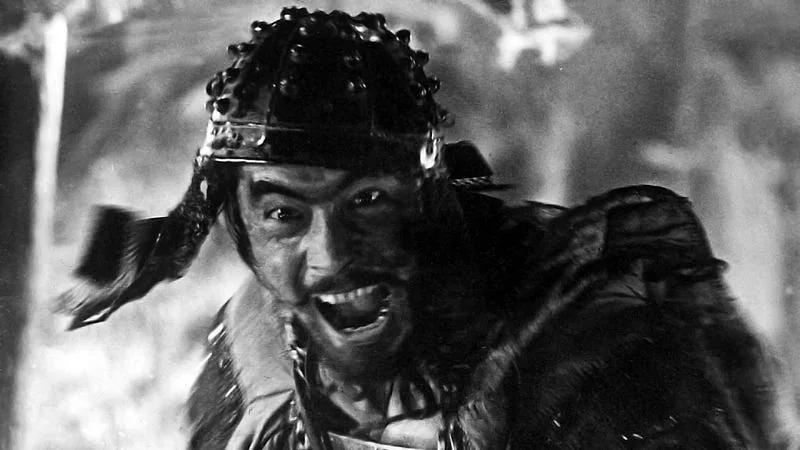
For most of the film he is the joke. Then the samurai find, hidden in a farmer’s house, a stash of armour, spears and helmets. The villagers have been killing wounded samurai fleeing from battles and stripping their bodies. The others are disgusted. Kikuchiyo explodes. Farmers are misers and liars and murderers, he shouts, and they are. Then:
But tell me this: Who turned them into such monsters? You did! You samurai did!
Kikuchiyo, Seven Samurai
He lists what samurai do to farmers in war, the burned villages, the trampled fields, the stolen food, and asks what the farmers are supposed to do. Kambei waits for him to finish, and asks quietly: “You were born a farmer, weren’t you?”
That is the secret of the character. He is not a samurai pretending, or not only. He is a farmer’s son who wanted to be on the other side of the line, and who knows both sides better than anyone else in the film. Later, when the bandits burn the mill at the edge of the village, a wounded mother staggers out with her baby and dies, and Kikuchiyo stands in the river with the child in his arms, weeping:
This baby… is me. This is just what happened to me!
Kikuchiyo, Seven Samurai
He dies in the final battle, in the rain, killing the bandit chief who has just shot him. He is buried on the hill with the samurai, under a sword.
The farmers
The farmers are not saints, and Kurosawa never asks us to pretend they are. They hide their food, their daughters and their stolen armour. When the samurai decide that three outlying houses cannot be defended, the men who live there throw down their spears and walk off the line. Kambei chases them back with a drawn sword, and then tells the village what he has learned in a lifetime of losing wars:
This is the nature of war: By protecting others, you save yourself. If you only think of yourself, you’ll only destroy yourself.
Kambei, Seven Samurai
Manzo, terrified of what samurai do to village girls, cuts off his daughter Shino’s hair and dresses her as a boy. It does not stop her falling in love with Katsushiro. The old man who told them to find hungry samurai refuses to leave his mill when the bandits come, and dies in it.
And there is Rikichi, the angriest of the farmers, who wanted to fight from the start. When Heihachi teases him about a wife, he flares up: “I don’t have a wife!” The truth comes out on the raid on the bandits’ camp. Among the women the bandits keep there, one sees him and runs back into the burning house. She was his wife, carried off by the bandits, and she would rather die than face him. Heihachi is shot trying to hold Rikichi back from the fire.
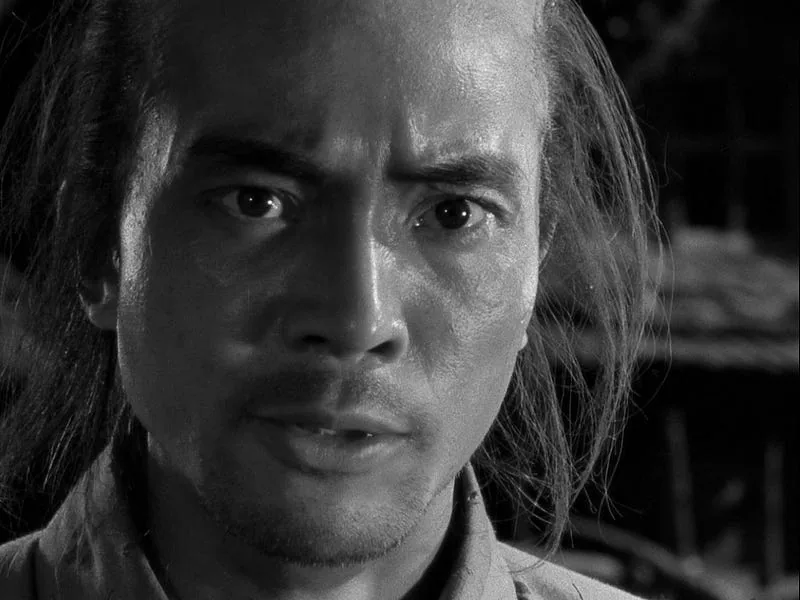
Indian audiences know this story in another shape. Sholay also hires fighting men to save a village from a bandit who has taken something no one can give back. It just decided that two heroes would do the work of seven.
Who won
So back to the hill. Four of the seven are dead: Heihachi, Gorobei, Kyuzo and Kikuchiyo. The bandits are gone. The farmers have their rice, their fields and their song, and they have already gone back to the work they were doing before any of this began. Shino walks past Katsushiro without stopping. She has a field to plant.
Kambei’s line is not bitter. It is the clear sight of a man who has always fought for someone else. The samurai fought, and some of them died, and they will move on with nothing, as they came. The farmers endure. They were the ones with something to defend, and the film ends with them doing it.
That is where the humanity in Seven Samurai lies. It is not that its heroes are good men; most of them are. It is that the film lets us see both sides of the line, the farmers’ meanness and the reason for it, the samurai’s courage and its cost, and buries the one man who belonged to both among the samurai he wanted to be.
References
- Seven Samurai, directed by Akira Kurosawa (Toho, 1954), the Criterion Collection edition. Dialogue is quoted from its English subtitles.