Ancient → Modern
The Fourth King
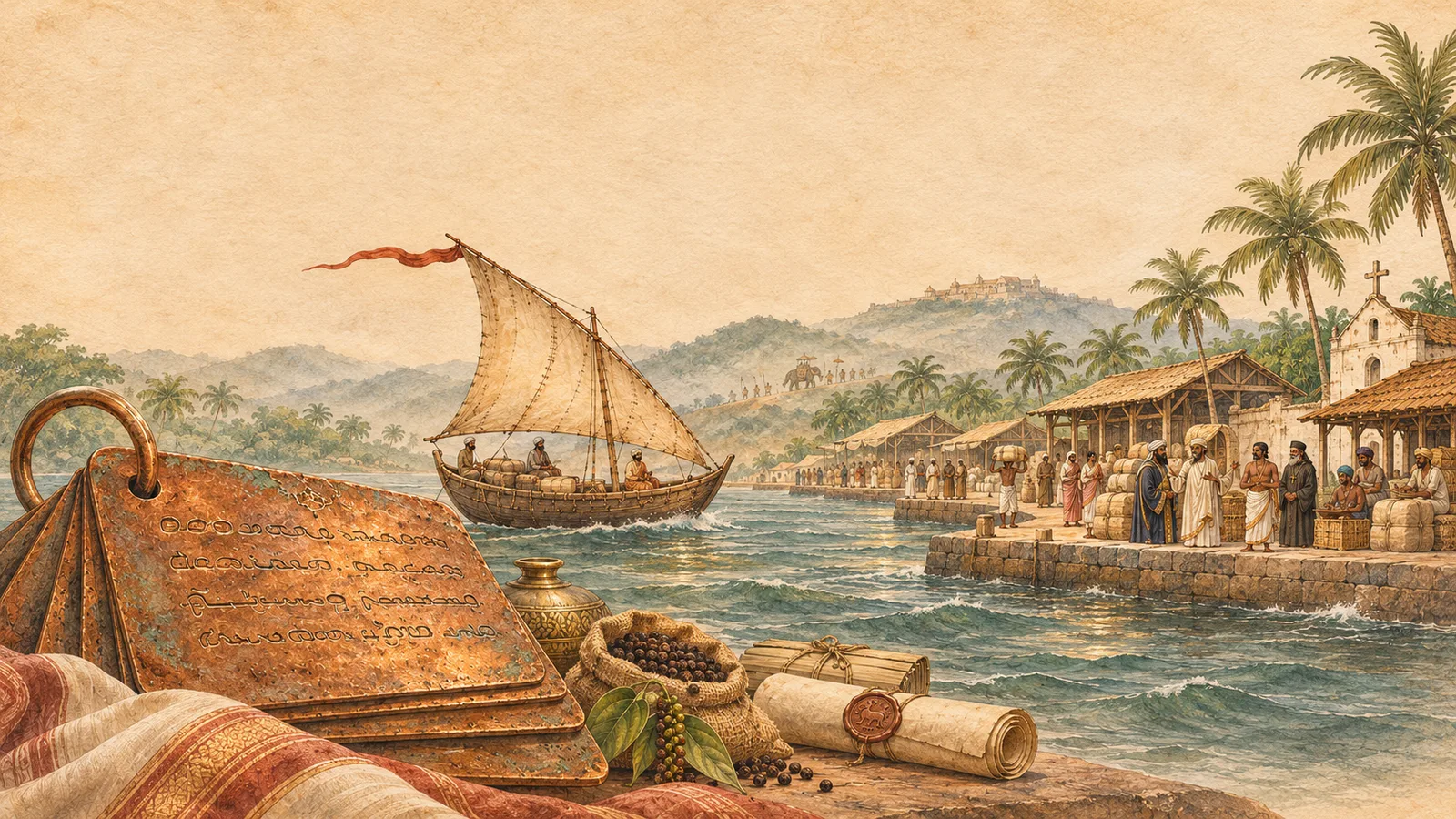
In 851 a merchant's book from the Gulf named the four great kings of the world, and one of them ruled from the Deccan. India as the traders of the sea road saw it.
On this page
India as the merchants saw it, 851 CE
I have been reading a very old book.
My copy is an English translation printed in London in 1733, made from a French translation of the Arabic. That is a long way to stand from anyone’s words. But the men in it are merchants, and merchants sound the same in any language: what it cost, how long it took, who could be trusted.
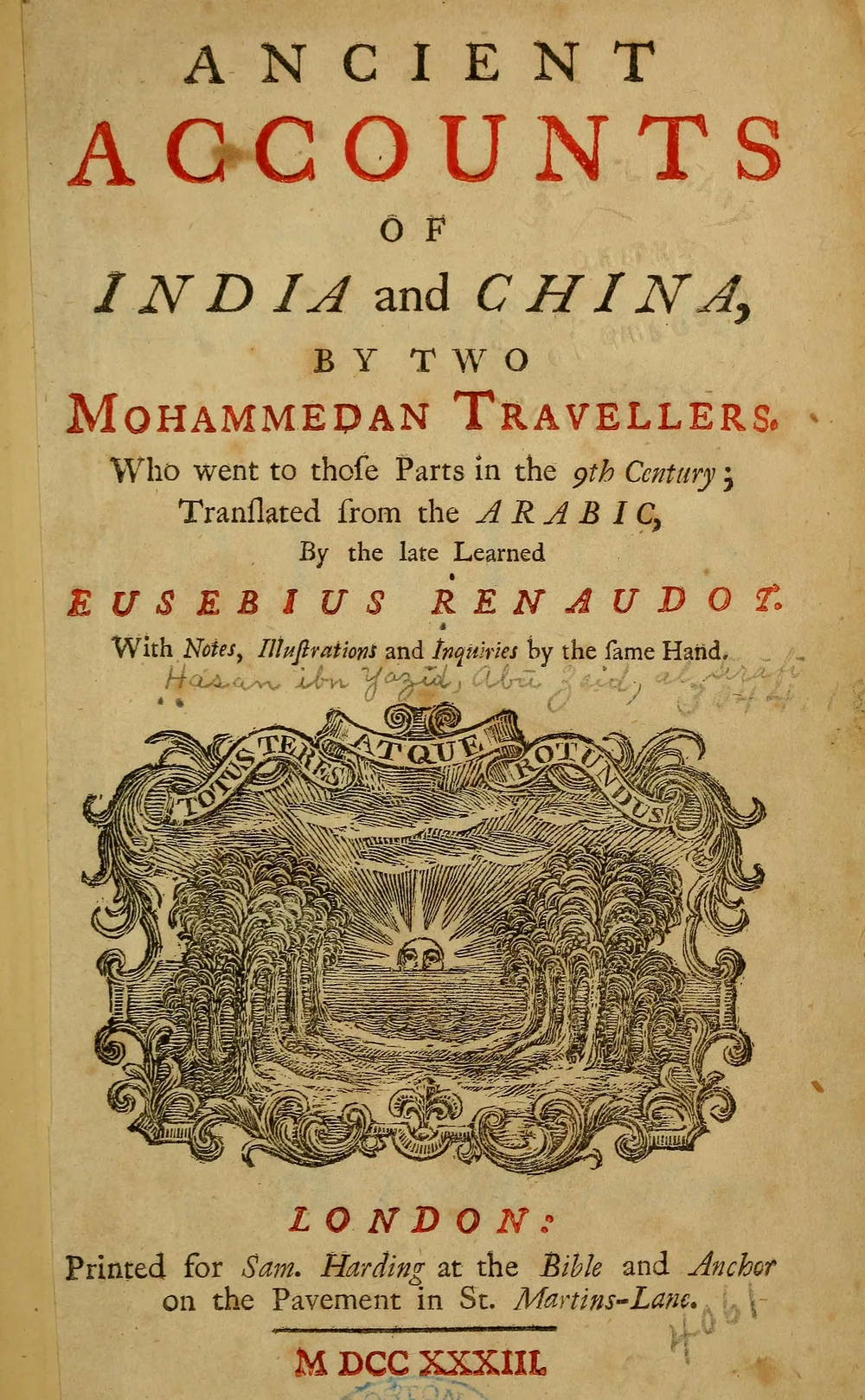
The stories were first written down in 851, somewhere in the Gulf. We don’t know the writer’s name. He sat with men who had come home from India and China, and he put down what they told him. About sixty-five years later a second man, Abu Zayd of the port of Siraf, was handed that book and asked to check it against what he had heard himself. He found most of it true, and added stories of his own. Together the two books are the oldest Arabic account we have of the sea road from the Gulf to China.
A lot of it is what you would expect from a ship’s crew. Where the fresh water is. How many days to the next port. And then, a few pages in, there is this:
Both the Indians and Chinese agree, that there are four great or principal kings in the world.
The first, the book says, is the king of the Arabs: the caliph in Baghdad. Then the Emperor of China. Then the king of the Greeks, in Constantinople. And the fourth is an Indian king, whom the merchants call the Balhara.
I sat up when I read that. Somebody in the ninth century made a list of the great powers of the world, and one of the four was in the Deccan. I wanted to know who he was. I also wanted to know what Arab merchants were doing in his country, and what they made of it.
A month’s sail, with the wind aft
The voyage began at Siraf, on the Persian side of the Gulf. The big ships loaded there, and cargo from Basra was brought down to them, because the waters further up were shallow and stormy.
Anyone from the Mediterranean would have stared at these ships. There was not a nail in them. Abu Zayd says that only the ships of Siraf were built this way, their planks “not nailed, but joined together in an extraordinary manner as if they were sewn”. Once, he says, the wreck of such a ship washed up on the coast of Syria, and people knew where it had come from by its stitches.
From Siraf they went down the coast to Muscat, filled their water jars at the wells, took cattle on board, and waited. When the monsoon turned, they let it carry them:
From Mascat to this place, it is a month’s sail, with the wind aft.
“This place” was Kollam, on the Malabar coast. The book tells us it had fresh water, and that the customs men took a thousand dirhams from the big Chinese ships and between one dinar and ten from everybody else. That is the first thing a merchant wants to know about a port, so it is the first thing we are told about India.
Most ships watered there and sailed on, towards Sri Lanka and China. Some of the men stayed.
The witnesses
We know they stayed, because a few of them signed their names.
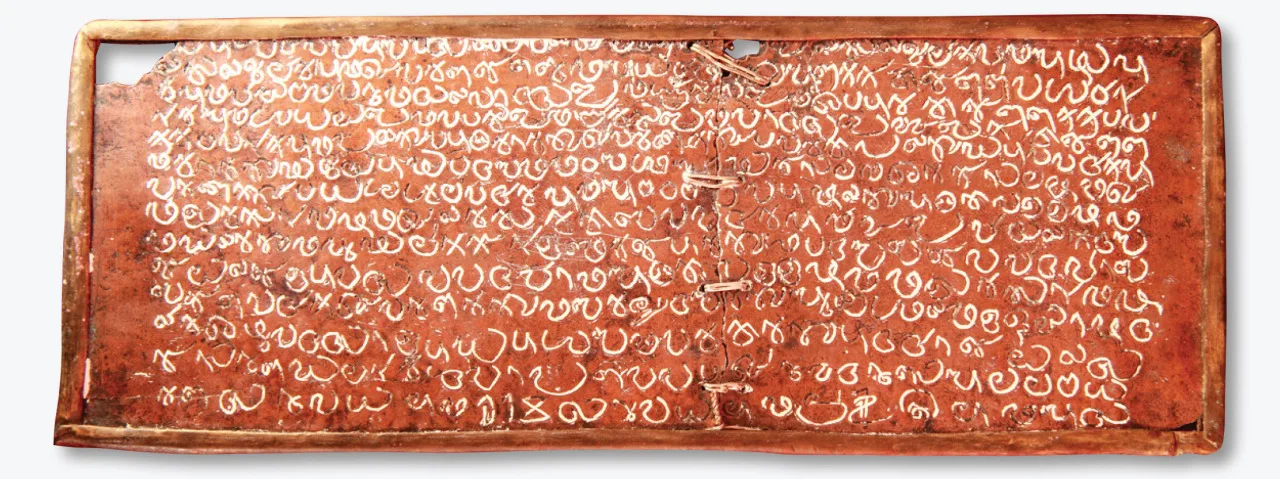
In 849, two years before the first book was written, the chieftain of Kollam, Ayyan Adikal, gave away some land. It went to a Christian merchant named Mar Sapir Iso, who had founded a trading town there and built a church. The grant was cut into copper plates in old Malayalam letters: the land, the rights that went with it, the merchant guilds who would look after it.
The last plate was for the witnesses. Maymun, son of Ibrahim, signed in Arabic, in the square Kufic script of the early Qur’ans. Muhammad, son of Manih, signed after him. Other men signed in Pahlavi, the script of old Persia, and others in Hebrew letters.
So in a hall on the Kerala coast, Arab Muslims, Persians and Jews stood witness to an Indian chieftain’s gift to a Christian’s church. Nobody there seems to have found it remarkable. It was a property deed.
The plates survive, and two churches in Kerala still keep them.
Men like Maymun were the ones who carried India home in their heads, and told it to whoever would listen.
The fourth king
What they told, before anything else, was that the greatest king in India was their friend.
This Balhara is the most illustrious prince in all the Indies; and all the other kings there, though each is master and independent in his kingdom, acknowledge in him this prerogative and pre-eminence.
He had more horses and elephants than could be counted. He struck his own silver coin, a little heavier than the Arab dirham, and stamped it with the year of his own reign. And then comes the part the merchants cared about most:
In truth, there are no princes more heartily affectionate to the Arabs; and their subjects profess the same friendship for us.
They had even been given a reason for it. The kings of this line lived a very long time, many of them ruling for more than fifty years, and the people of the country believed their long lives were “granted them in recompence for their kindness to the Arabs”.
The book never tells us his name. Balhara, it explains, is a title that passes from one king to the next.
It is. Balhara is what an Arab ear made of Vallabha-raja, “the beloved king”, a title of the Rashtrakuta emperors of the Deccan. In 851 their capital was Manyakheta, which is Malkhed today, a few hours’ drive west of Hyderabad, where I live. The king was Amoghavarsha. He was a Jain and a patron of poets, and the earliest book we have in Kannada came out of his court. When the merchants’ stories were written down he had been on the throne for thirty-seven years. He would stay on it for sixty-four.
So the merchants were right about the long reigns. As for the reason, I like to think of somebody in Amoghavarsha’s country saying it to an Arab trader with a straight face, and the trader going home and repeating it.
The king of wisdom
Abu Zayd has a second list of kings, and his comes with a story.
There was a man of Basra called Ibn Wahb, of the Prophet’s own tribe. When Basra was sacked, he left and came down to Siraf, where a ship was about to sail for China. “The mind took him to go on board,” the book says, and that is all the explanation we get. He landed at Guangzhou, travelled two months inland to the capital, and asked to see the emperor, on the grounds that he was a kinsman of the Prophet of the Arabs. The emperor did not take his word for it. He had the Arab merchants at the port asked about this man’s family, and only when they vouched for him was Ibn Wahb let in.
Abu Zayd met him many years later, an old man who still “had his senses perfectly about him”, and heard the rest from him.
The emperor asked what the Arabs thought of the other kings of the earth. Ibn Wahb said he did not know them. So the emperor told him, through an interpreter, that there were five worth counting. The king of Iraq was the king of kings, because he sat at the middle of the world. The emperor himself was the king of mankind, because no people obeyed their ruler as his did. The king of the Turks was the king of lions. The king of the Greeks was the king of men, for their looks and their manners.
And the king of India was the king of elephants. He was also, the emperor said, the king of wisdom, because wisdom came from the Indians.
Then the emperor sent for a box of pictures of the prophets, and Ibn Wahb picked out Noah in his ark. The emperor laughed. The name was right, he said, but the flood “reached not our country, nor even the Indies”.
That makes two lists in this book, one from the merchants and one from the Emperor of China, and India is on both. The merchants put it there for its king. The emperor put it there for what it knew.
They say, and I saw
Most of what the merchants tell is hearsay, and they never pretend otherwise. “They say” is on every page.
They say there was a king in the north, the king of Jurz, who had the best cavalry in India and hated the Arabs more than any other prince did. The merchants report this quite calmly, and then add the thing that mattered to them: “There is no talk of robbers in this country.” He was Mihira Bhoja, the Pratihara king at Kannauj. A man carrying silver could cross his lands in peace, whatever the king thought of his religion.
They say there was a king in the east, the king of Rahma, who took the field with fifty thousand elephants, and only in winter, because elephants cannot bear thirst. Rahma was Bengal, under the Pala kings, and you can tell from what comes next: cotton garments woven so fine “that they may be drawn through a ring of a middling size”. In the marshes of the same country, they say, lives a beast with a single horn on its forehead, so strong that the elephant runs from it. Look closely at the horn and you will see figures in it: men, peacocks, fishes.
And then, about this rhinoceros, the writer suddenly speaks for himself:
His flesh is not forbidden, and we have eaten of it.
There are a few moments like this, where “they say” gives way to “I saw”, and they are the lines I trust most.
He describes how a man accused of a crime that carried death could clear himself. A cauldron of water was boiled, an iron ring was thrown in, and he had to put in his hand and bring the ring out. If he was unhurt, his accuser paid a fine in gold. “I saw one who did this,” the writer adds, “and received no manner of hurt.” He does not try to explain it.
He describes holy men who lived in the woods on wild herbs and fruit, naked or with only a leopard’s skin thrown over them, standing with their faces turned to the sun.
I formerly saw one in the posture I have described, and returning to the Indies about sixteen years afterwards, I found him in the very same attitude, and was astonished he had not lost his eyesight by the heat of the sun.
Sixteen years. In that time the merchant had gone home, bought and sold, grown older and come back. The other man had stood where he was. And when the merchant sees him again, what he thinks about is the man’s eyes.
The life of the Indians
The India in these pages is very wet.
Every summer the rains came, for three months, night and day. People got ready for them, and when they arrived, shut themselves up in houses of wood and woven cane, thatched with leaves. Nobody was seen outside. Even the craftsmen did their work at home, and everyone got sores on the soles of their feet from the damp. And still:
These rains are the life of the Indians; were they to fail, they would be reduced to the deepest want.
Eleven centuries later, we still watch the June sky in just that way.
Abu Zayd noticed how much of ordinary life here went into earning merit. A naked ascetic, with an earthen bowl hanging from a string round his neck, would stop at a door, and the people of the house would “immediately and joyfully bring out rice”. People built inns along the highways for travellers. Pilgrims walked for months to the Sun temple at Multan, carrying costly aloes-wood to be burned before the idol. He did not admire all of it. The poets, he says, wrote verses to their kings “stuffed with flattery”.
And then he says this, which is the picture I would most like to keep from the whole book:
There are, among the Indians, certain men who make profession of piety, and whose devotion consists in seeking after unknown islands, or such as are newly discovered, there to plant coco-nut trees, and to sink wells of water for the use of ships that sail to those parts.
They planted trees and dug wells on empty islands, for sailors they would never meet. I wonder how many Arab crews filled their jars at one of those wells without knowing who had dug it.
Without emotion or wonder
The same devotion had a harder side, and the merchants told that too.
When a new king came to the throne, Abu Zayd says, rice was cooked and laid out on leaves in front of him. Three or four hundred men came forward “of their own accord, without the least constraint”. The king ate a little of the rice and gave a little to each of them, and they ate it before him. With that mouthful they promised to enter the fire on the day he died. They kept the promise, he says, to the last man. He tells of old people who, feeling their strength go, asked their families to give them to the fire or to the river, sure that they would return in another body.
What stays with me is how these stories reached him.
The person who related these things to us, did it without emotion or wonder … for this part of the Indies is in the neighbourhood of the country of the Arabs, and we hear from thence every day.
We hear from thence every day. To the people of Siraf, India was the neighbour across the water, and its news came in with every ship. They heard about its fires the way they heard about the price of pepper.
The verdict
The first book ends the way a trader ends a report, with the two markets side by side.
China has more cities, large and walled, and it is peopled from one end to the other, where India has its empty tracts. China has more horses, and a healthier climate. But India is the bigger country, with more kingdoms in it. Medicine and philosophy are cultivated there. In astronomy, “the Indians surpass the Chinese”. The Chinese, he adds, took their religion from India, and “consider them as a very religious nation”.
Then comes a sentence that shows where he had been standing all along:
I know not that there is any one of either nation that has embraced Mohammedism or speaks Arabic.
Abu Zayd is blunter. After describing the girls given to India’s temples, he stops and thanks God, “who hath chosen us to be free from the sins which defile the men involved in infidelity”.
They admired India’s kings and its learning, they feared for its soul, and they wrote both down without trying to settle the matter. I don’t hold it against them. They wrote what they saw and what they believed, and kept the two apart.
What they could not know
In 926, on the Konkan coast north of today’s Mumbai, another grant was cut into copper, this time under the Rashtrakutas. It names the man who governed the district. In the Sanskrit of the plate he is Madhumati, son of Sahiyarahara.
Say the names aloud and they turn back into Muhammad, son of Shahriyar. A Muslim, the son of a Persian, governing a stretch of the coast for the Balhara.
It would be easy to read the merchants’ line about friendship as a boast. No princes more affectionate to the Arabs: they would say that, wouldn’t they? But here is an Indian record, made for Indian reasons, saying the same thing without meaning to.
The merchants were wrong about the pictures in the rhinoceros horn. They were right about the friendship.
There is a copper plate at each end of this story. At Kollam, in 849, Arab traders are written into an Indian deed as witnesses. On the Konkan, seventy-seven years later, a Muslim is written into another as the governor. Between the two sits a small Arabic book, in which the same people wrote down what they saw of India.
The Balhara’s capital is a small town now, and Siraf is a ruin on the Gulf shore. What is left of the friendship is what each side wrote about the other: a few lines in copper, and a book of sailors’ stories that reached me in English, eleven centuries later, a few hours’ drive from where the fourth king held his court.
That’s my learning for today!
References
- Ancient Accounts of India and China, by Two Mohammedan Travellers, Who Went to Those Parts in the 9th Century (London, 1733). The English translation of Eusèbe Renaudot’s French of 1718, from the Arabic Akhbar al-Sin wa’l-Hind of 851 and Abu Zayd al-Sirafi’s sequel. Every quotation here is from it, with the spelling modernised.
- Quilon Syrian copper plates (Wikipedia). The grant of 849 to Mar Sapir Iso, its witnesses in Kufic, Pahlavi and Hebrew script, and the two churches that keep the plates.
- Abu Zayd al-Sirafi (Wikipedia) and Sulaiman al-Tajir (Wikipedia). The two books and the merchant the first is often attributed to.
- Balhara (title) (Wikipedia). The Arabic form of Vallabha, the royal title of the Chalukyas and the Rashtrakutas.
- Amoghavarsha (Wikipedia) and Rashtrakuta dynasty (Wikipedia). The Balhara of 851, his reign of sixty-four years and his capital at Manyakheta.
- Mihira Bhoja (Wikipedia) and Pala Empire (Wikipedia). The kings of Jurz and of Rahma.
- Multan Sun Temple (Wikipedia). The idol the pilgrims walked to.
- Chinchani plates of the time of Indra III, Saka 848 (926 CE), published in Epigraphia Indica XXXII. The grant naming Madhumati, son of Sahiyarahara, as the Rashtrakuta governor of Sanjan.