Ancient → Modern · Indian Thought
Before the Kakatiyas: An Evening at Nandikandi
Another journey into Hyderabad before Hyderabad: a star-shaped Chalukya temple at Nandikandi, an inscription of 1014, and a regional chief named Pampa Permanadi.
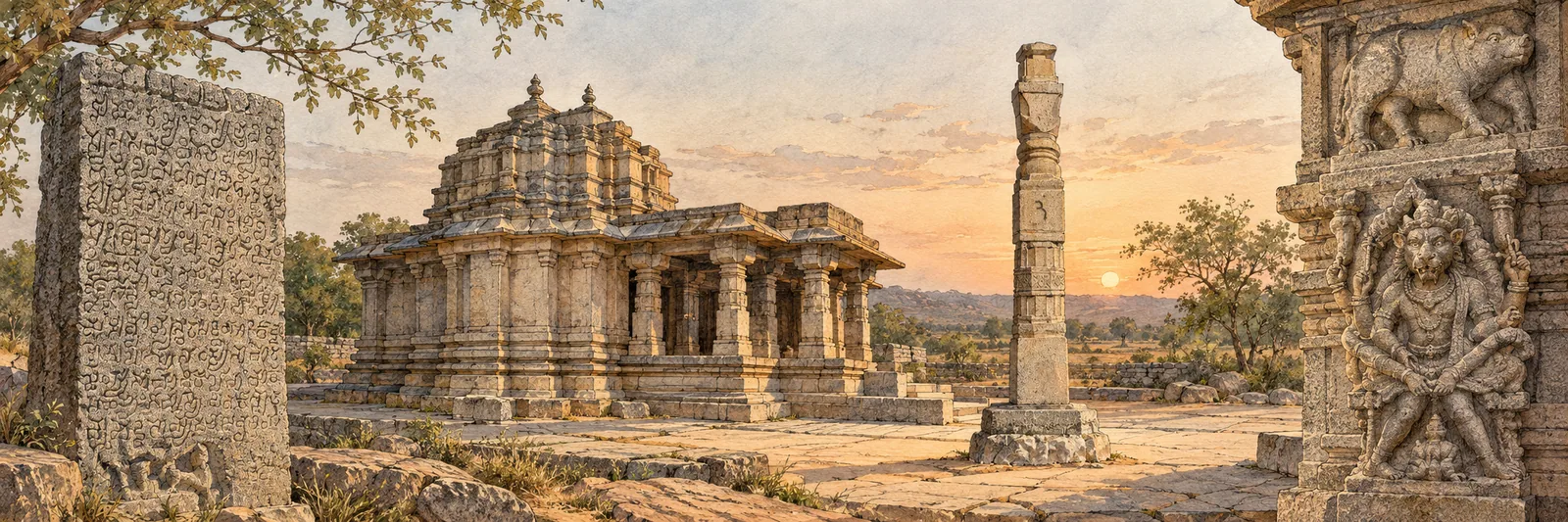
Another journey into Hyderabad before Hyderabad
Ask someone in Telangana about our history, and there’s a good chance the story will begin with the Kakatiyas. Warangal, Rudrama Devi, the Thousand Pillar Temple. And rightly so. The Kakatiyas left us an extraordinary legacy.
But what came before them?
Until recently, I wouldn’t have had much to say either. It isn’t that Telangana lacks an older history. It is that so little of it enters our everyday conversations. We pass old villages, temples and rocks without knowing what happened there a thousand years ago.
While writing Hyderabad Before Hyderabad, I began looking for old names hidden inside familiar places. I found Tellapur in an inscription, Velimela under an older name, and Jayasimha II of the Western Chalukyas holding court at Pottalakere, today’s Patancheru. That last discovery stayed with me. A king I had read about in history had once been just a short drive from home.
Since then, the more I read, the more places I want to visit. Telangana seems to have a habit of hiding its best stories in places we rarely think of visiting.
On the evening of 13 October, I went to one of them: Nandikandi, near Sangareddy.
There is an old Ramalingeshwara temple there. I knew it belonged to the Western Chalukya period, but seeing it was different from reading about it. The base of the shrine doesn’t follow a simple square. Its walls turn at angles, giving it a star-like shape. Walk around it and the building keeps changing with every few steps.
The tower has features associated with the Bhumija style: a square plan rotated about its centre, with rows of miniature spires climbing each face. The style was worked out in Malwa, in central India, under the Paramaras in the tenth century, and then travelled south into the Deccan. That is a detail worth pausing on. The Paramara king Bhoja was one of the enemies Jayasimha II spent his reign holding off. Armies went back and forth across that frontier. So, it seems, did ideas about how to build a temple.
We usually think of the great Hoysala temples when we think of such shapes. Nandikandi belongs to an earlier Chalukya setting, though the exact date of the stone building still needs to be established. I spent a while looking at it, wondering who decided to try this design here, and what other temples those builders had seen.
Then my attention moved from the temple to a stone standing outside it.
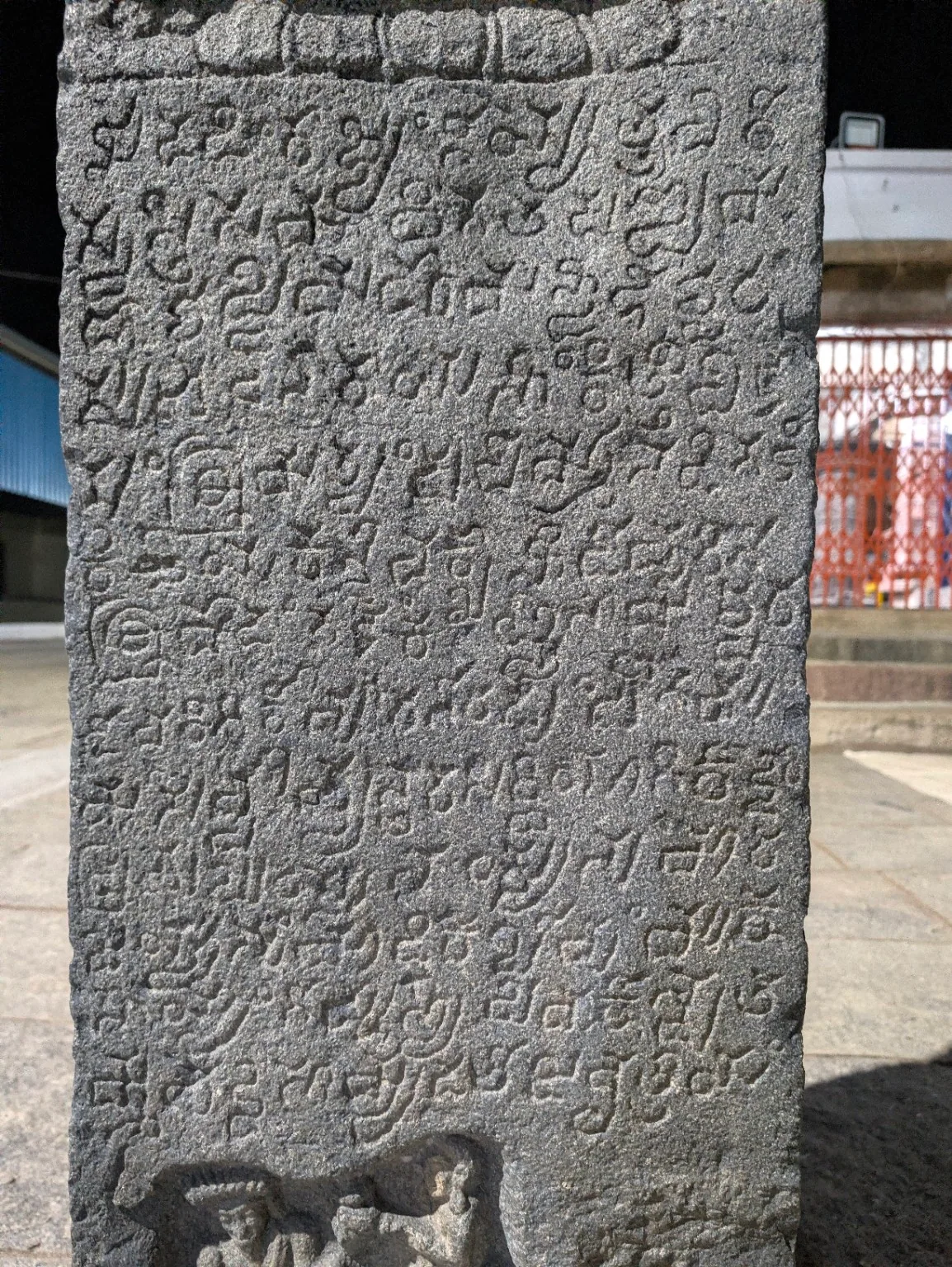
The inscription runs across four faces. I couldn’t read it, but near the lower part of the side I photographed was a carving: one person appears to be washing another person’s feet. It seemed like a strangely specific moment to preserve in stone.
Later, when I looked up the published inscription, I found what may explain it.
A record dated to 1014 CE mentions a man named Pampa Permadi, also written Pampa Permanadi. He was a mahamandaleshvara, a powerful regional chief serving the Western Chalukyas. During the reign of Vikramaditya V, he made a grant for the worship of a deity called Namesvara, after ceremonially washing the feet of a religious teacher named Vakhana Deva (the reading of the name varies). The record refers to Kiriyakandi, an old name for Nandikandi. Other chiefs made provision for feeding fifty ascetics and students.
So that small scene might be showing a ceremony much like the one described in the words above it. We can’t yet prove that the figures represent Pampa and the teacher. Still, the connection was enough to make me curious about the man behind the donation.
The teacher’s name travelled further than I expected. A record of 1062 from Kosigi, far to the south on the Karnataka border, names a Jnanasakti Pandita as the disciple’s disciple of a Vakkanadeva of Kandi. If that is the same man whose feet were washed at Nandikandi, his students were carrying his name across the Deccan half a century later. The small village I was standing in had once been home to a teacher people remembered a long way away.
The kings of the Western Chalukya dynasty are reasonably easy to find in history books. Pampa Permanadi isn’t. Yet when I searched for his name in inscriptions from the surrounding region, he kept appearing.
In 1024, a record at Khadarabad mentions him administering territory from Morakhandi. In 1026, at Mubarakpur, an inscription records Pampa Permanadi himself giving land to a Jain basadi, after washing the feet of a Jain teacher named Ramachandra Siddhanta Bhattaraka. A 1048 record from the old Medak region places another Jain basadi endowment inside a territory governed by Pampa. Around 1050, at Nagulapalli, close to where I live, a subordinate acting on his orders made a grant to a teacher named Someshvara Pandita in a Shaiva temple.
Those are not small details. They show a regional chief whose authority reached several settlements, whose subordinates carried out grants, and whose name appears in records connected with different religious institutions. In some of these places he is the donor; elsewhere he is the official under whose authority a donation was made.
A picture of the man begins to form. The records call his territory Kasavula-70, a district conventionally read as seventy villages, in the old Medak country. A damaged record from Devanuru gives him a string of titles: crest jewel of the chiefs, crown of heroes, cause of victory in battle. Another, from Velturu, names his wife, Jakkaladevi. And the Nagulapalli grant was no token. It gave 150 marttars of land to Someshvara Pandita as a fee for the teaching he had given, four hundred more to a hundred and twenty-two scholars, and had a hundred and fifty village headmen stand witness. The Nagulapalli record shows a regional administration paying for a school.
The name turns up again in a record from 1069. If it is the same man throughout, we are looking at a career stretching over half a century, across the reigns of several kings. That is possible, but the epigraphists warn that more than one person may have carried the name. For now, I think of Pampa as a person we can begin to recognise, not someone whose full life we have recovered.
And it made me wonder about the temple I visited. Did he help build it? Did he only provide for worship at a shrine that was already there? The 1014 grant proves that a Shaiva institution was active by then. It doesn’t tell us when the temple’s star-shaped walls were built. Some of the surviving structure may be later.
A different inscription from Nandikandi mentions Ahavamalla, a title used by both Tailapa II and Someshvara I. If it refers to Someshvara I, who ruled in the middle of the eleventh century, it would fit the years in which Pampa or his political network was still active. But the inscription is damaged. We cannot use that title alone to date the building.
Not far from the inscribed stone stood a tall, separate pillar, away from the central line of the Shiva shrine.
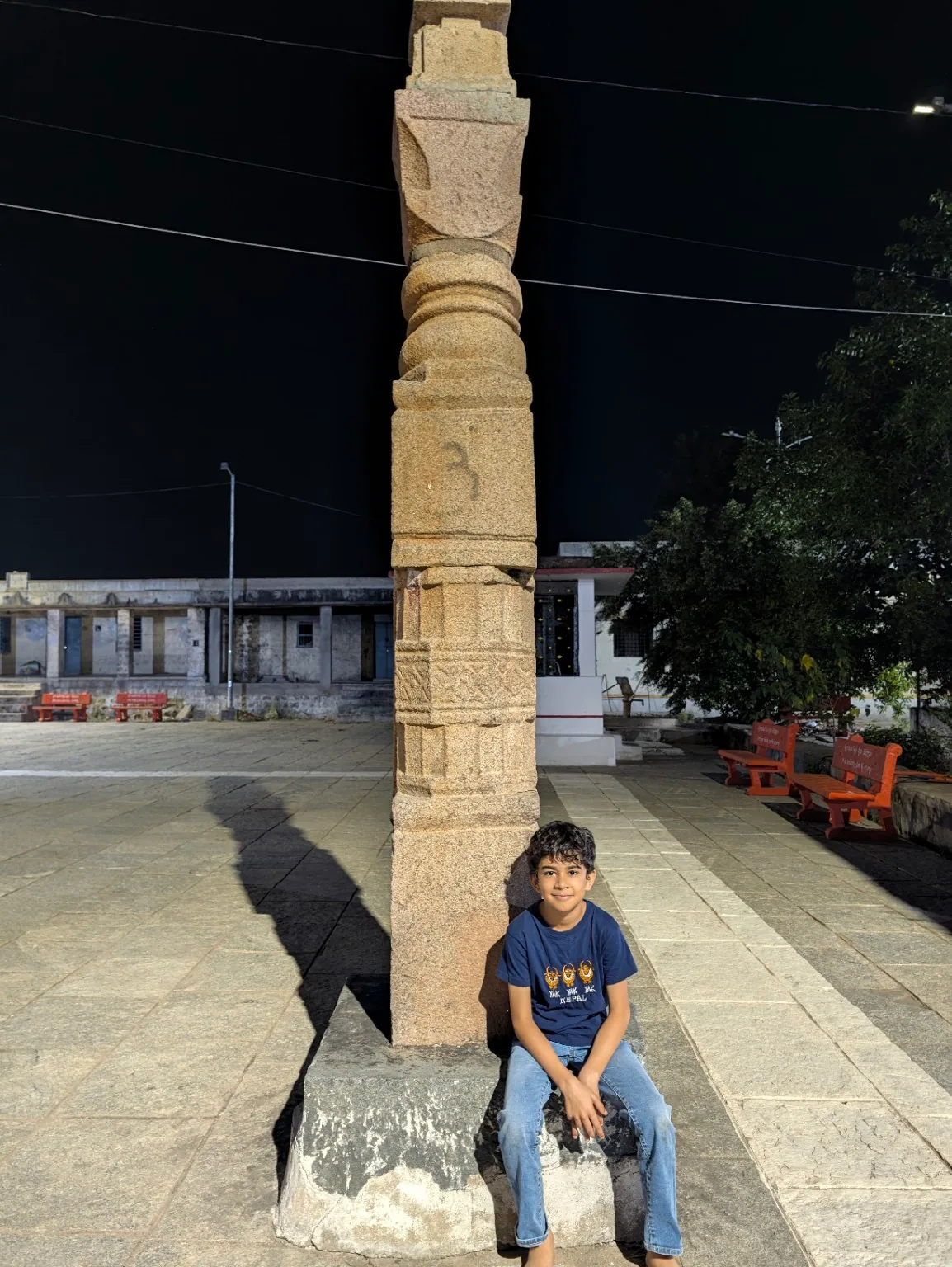
A damaged Nandikandi inscription carries the word jinakambha, a pillar associated with the Jina of the Jain tradition. This is that pillar: a Jain pillar standing beside a Shiva temple. Whether a Jain basadi once stood inside this particular temple compound is a separate question, and one the records have not yet answered.
But by now I had Pampa’s name in a Jain donation at Mubarakpur, another Jain institution in his territory, and a Jain pillar beside a Shiva temple. That combination made me want to look beyond Nandikandi.
There is a much clearer example at Kolanupaka, near Alair, not far from Bhongir. Today you can visit the Jain temple there and the Someshwara Shiva temple in the same village. Both traditions have deep roots in the place. In fact, a four-sided inscription dated 1125 records a grant to the Jain goddess Ambika. One of the people praised in that inscription, a commander named Swamideva, is described as devoted to Hari, Hara, Jina and Buddha: Vishnu, Shiva, the Jain teachers and the Buddha.
I find that line extraordinary. These were not four names casually put together by a modern writer. They appeared in a medieval inscription celebrating a man of political importance.
And Kolanupaka was not alone. A much earlier inscription from Kurhatti in present-day Karnataka, dated to 980 CE, remembers a local chief who built both a Shiva temple and a Jain religious establishment. It isn’t evidence that everyone lived without disagreement. They certainly had disagreements, and religious competition and conflict were part of medieval history too. But the idea that supporting one tradition required destroying another clearly doesn’t describe the whole period.
We often look at old religious monuments through today’s arguments. Standing at Nandikandi, I found myself wondering what we miss when we do that. A chief could give to a Shiva shrine and also support a Jain basadi. A village could have more than one religious institution. A commander could be praised for reverence towards four traditions. That is not a perfect world, but it is a much more interesting one than the simple stories we sometimes tell.
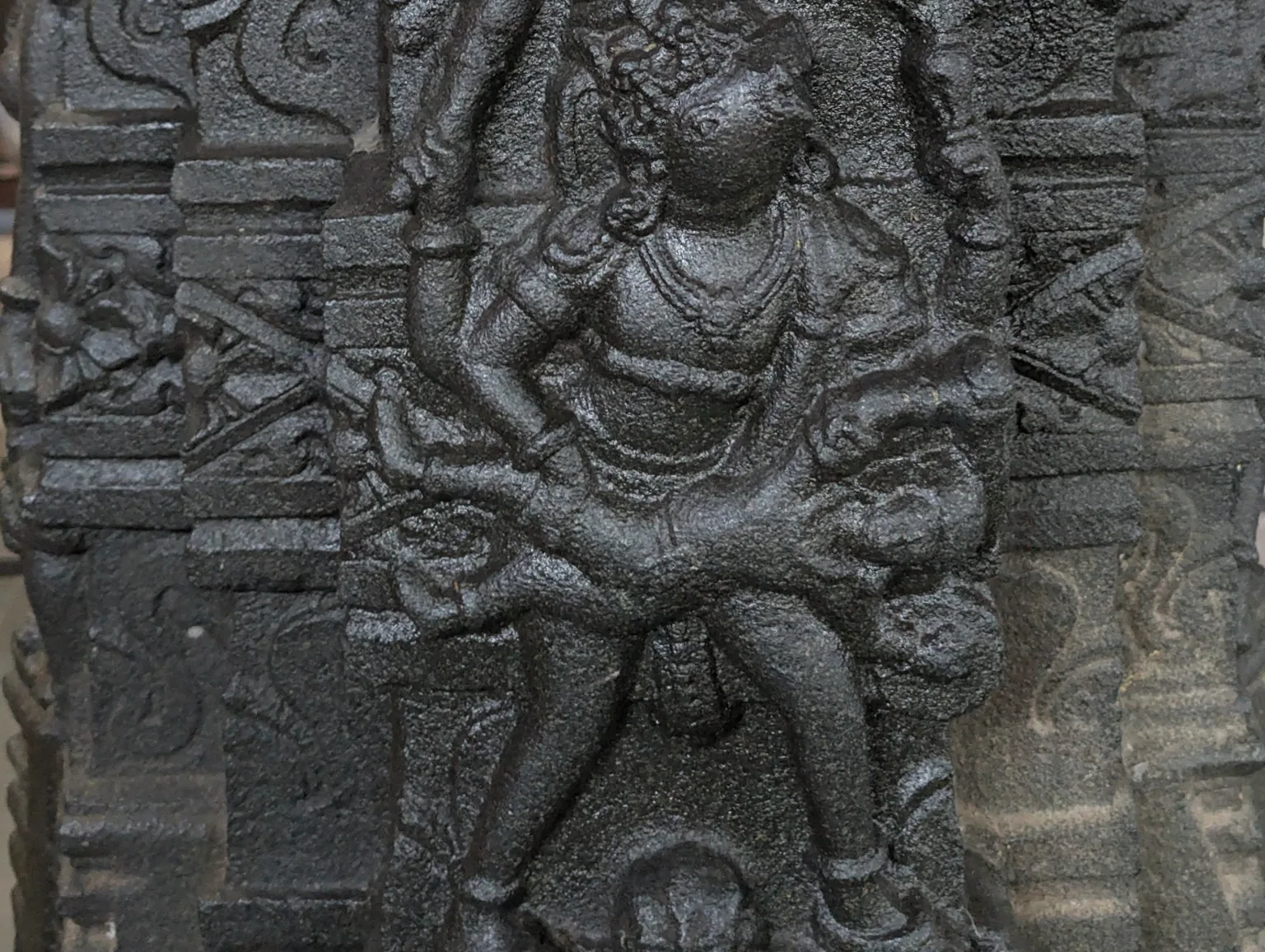
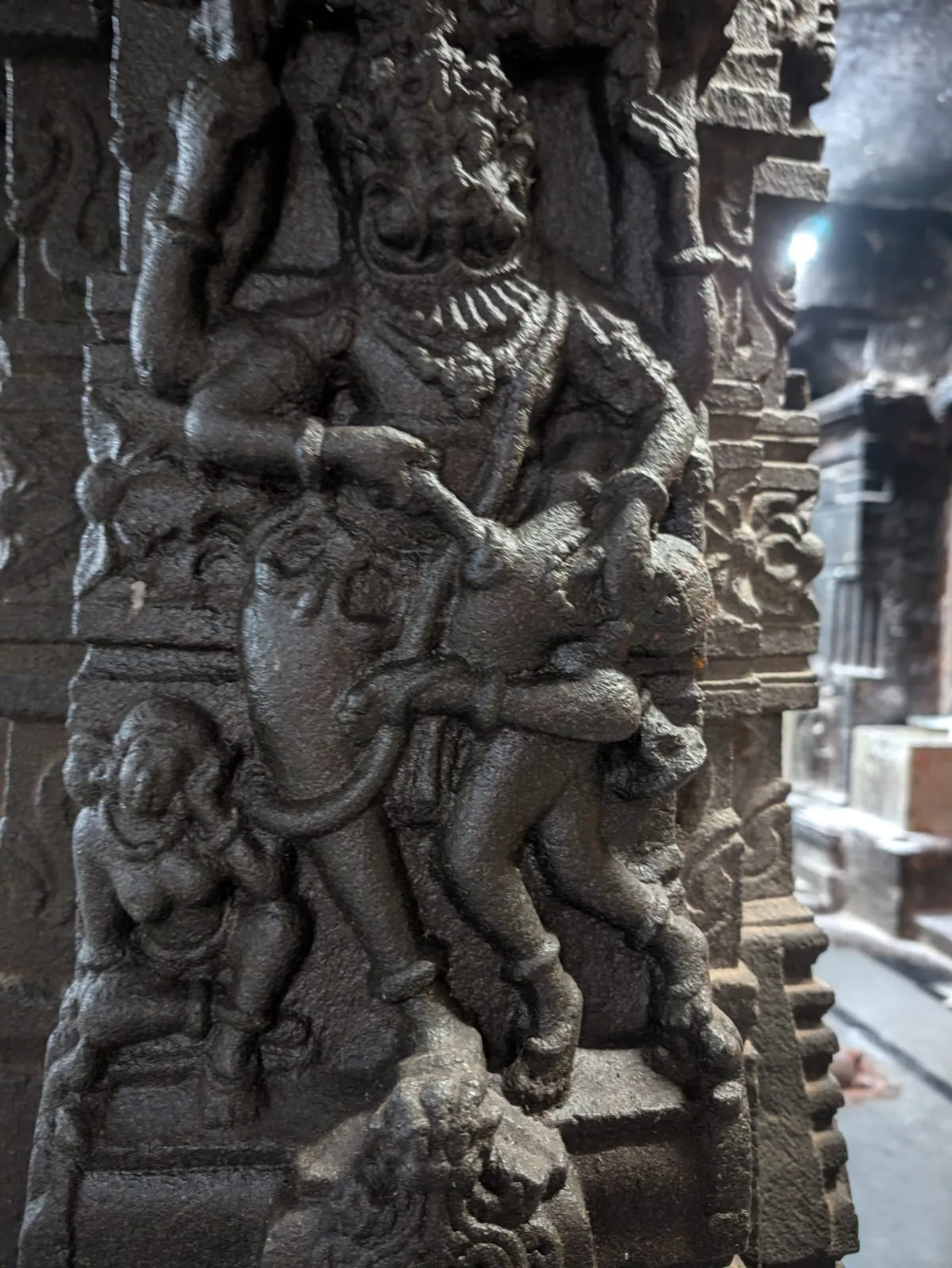
Even the carvings kept raising questions. On the pillars of this Shiva temple are Vishnu’s avatars, Varaha, Narasimha, Vamana. A few steps outside stands a Jain pillar. One site, three traditions, no sign that anyone thought this strange.
I had gone to Nandikandi to see an old temple. I came back thinking about the people who made such a place possible. The king whose reign gave the date to an inscription. The regional chief who assigned land and resources. The teacher whose feet were washed. The students and ascetics who were to be fed. And the builders who worked out how to make stone turn into a star.
There is still a lot I don’t know. I don’t know who built the temple we see today. I don’t even know whether every inscription naming Pampa Permanadi speaks of the same man.
But perhaps that is why these places deserve more attention. Their stories have not been neatly packaged for us. We have to go looking for them.
In Hyderabad Before Hyderabad, I wrote about discovering an older world beneath the names of places I know. Nandikandi has added another part to that world. Long before the Kakatiyas became the names most of us associate with Telangana’s past, this region already had ambitious builders, powerful local chiefs, religious teachers, Jain basadis and Shaiva temples.
There must be many more Nandikandis around us. I intend to keep looking.
If you would like to see it yourself, Nandikandi is here on the map.
Research notes: The Nandikandi, Khadarabad, Mubarakpur, Manjira-Hussaini Nagar, Nagulapalli, Devanuru, Velturu, Kosigi and Kohir records are summarised in Epigraphia Telanganica, Volume I. Kolanupaka’s shared Jain and Shaiva heritage is documented by the district museum of the Telangana Department of Heritage. The 1125 Kolanupaka inscription is described in the same epigraphic volume; the 980 Kurhatti record appears in South Indian Inscriptions, Volume XI, No. 45. The construction date of the present temple is still unverified.