Ancient → Modern · Indian Thought
Hyderabad Before Hyderabad
A search through inscriptions turned the western edge of Hyderabad, and the place I call home, into a much older neighbourhood.
On this page
The king I admired from a thousand years away had once camped close to my home. That was only the first thing this neighbourhood had kept from me.
For years, I have had a favourite medieval king: Jayasimha II of the Western Chalukyas, known by the title Jagadekamalla.
He ruled in a difficult age. Rajendra Chola I pressed from the south, Bhoja of Malwa from the north, and Gangeyadeva of the Kalachuris from the east. It is easy to admire a king who held his ground against that kind of pressure. I had admired him in the usual way we admire people from history: at a safe distance, in a world that no longer touches ours.
Then I came across the Saidapur inscription.
In 1034, during a lunar eclipse, Jagadekamalla was at a royal camp when a grant was made at the request of Aggalayya, a royal physician connected with Jain institutions. The inscription praises his learning and surgical skill. I paused over the picture it gave me: a king managing a kingdom under strain, the moon darkening overhead, and a physician with enough standing to ask for something and receive it. The Saidapur inscription preserves the occasion.
The camp was at Pottalakere. Scholars identify Pottalakere with Patancheru.
I know Patancheru. It is on the western side of Hyderabad, close to where I live. A king I had placed firmly in the distant past had conducted the business of his kingdom in my neighbourhood.
There may have been earlier royal camps there too. Copper plates issued under the Chalukya ruler Vijayaditya in 700 CE mention Pottalikanagara, which their editor cautiously connected with Pottalakere. The identification is not certain, but it is tempting to imagine this place receiving kings for centuries before Jagadekamalla arrived. The Mayalur plates leave the question open.
A name on a stone
I had not begun with the king. I began with Tellapur.
An inscription dated 1418 calls the village Telumganapura, also written Telunganapura. There it was, inside an unfamiliar old name: Telangana. The Tellapur inscription made a place on a contemporary map feel suddenly much deeper.
That small discovery changed the way I looked around. I started reading catalogues of inscriptions, looking for names I knew. The catalogues kept answering back. Patancheru was one answer. So were Chilkur, Keesaragutta, Chaitanyapuri and finally Velimela, where I live.
The names were familiar. The places were not.
The world around Pottalakere
Near Patancheru bus stand, a place I have passed more than once without really looking, are Jain remains from earlier centuries. This short record of the site was a useful correction to my confidence. Nearby at Pocharam, an ancient Jain sculpture has also been reported. Telangana Today reported the discovery.
The Jain thread runs beyond Patancheru. At Chilkur, an inscription dated by its editor to 1012 records a grant to the Jain Tirthankara Pārśvanātha. It was made during the rule of Vikramaditya V of the Western Chalukya house, two decades before Jagadekamalla’s camp.
The record names Padmanabhayya, an official responsible for a territory called Lombulike-70. The number may refer to a group of seventy villages. A later inscription identifies Chilkur as the territory’s headquarters. It is a different way to see a place usually introduced as Hyderabad’s Visa God temple: once, other settlements were administered from here.
A monk inside today’s city
The search then took me to Chaitanyapuri, near Dilsukhnagar, on the other side of today’s city.
At the Phanigiri Lakshmi-Narasimha temple, a boulder bears a six-line Prakrit inscription. Its script has been assigned to the fourth century. It names Govindarāja-vihāra, King Govinda’s monastery, and a monk called Saṅghadeva, who established a residence and was responsible for the monastery’s gandhakuṭi, its perfume chamber. Scholars identify King Govinda with the Vishnukundin ruler Govindavarman. The inscription and translation, a site catalogue, and the original study preserve these few lines.
I had been collecting old place names. Suddenly I had a person: Saṅghadeva, named across sixteen centuries, with work to do and a building to care for. He is the oldest named individual I have found in this search.
Six lines cannot tell us everything. They do not tell us who supplied the monastery, who came to it, or what stood around it. But they make those questions unavoidable. A monastery needs food, repair, visitors, patrons and paths leading to it. A small inscription can open a whole missing world.
The people who made the stones
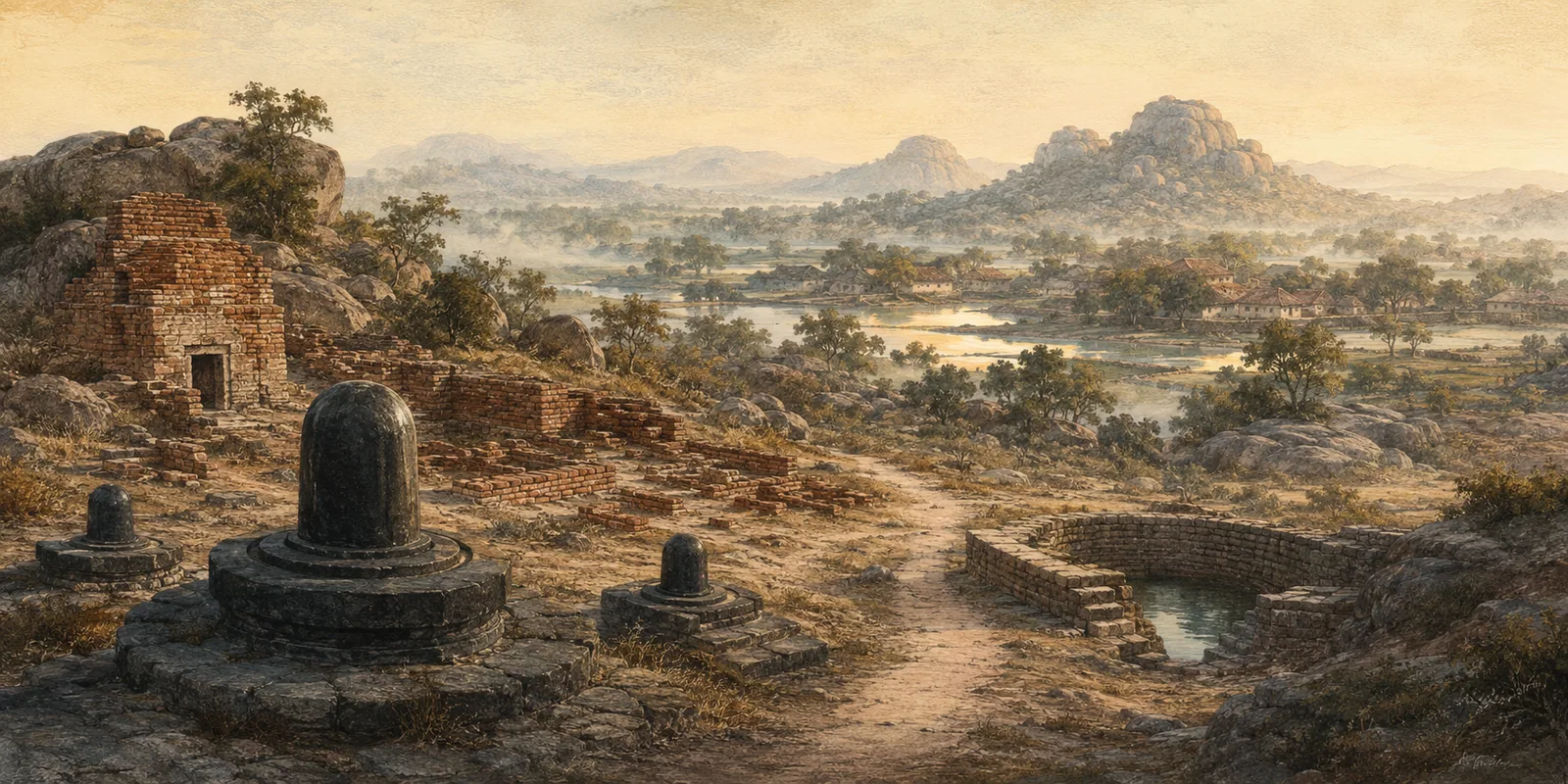
At Keesaragutta, the Vishnukundins appear again. Excavations found fortification walls, brick structures, shrines and coins from their period. Among the discoveries were thirty black-basalt lingas in four rows on brick pedestals. The ASI excavation report also records a label it reads as Toluchuvandru, which it interprets as carvers.
That word stayed with me.
When we meet a stone object centuries later, it can feel as if it simply appeared, already ancient. “Carvers” brings back the missing hands. Someone chose the stone, learned where it might crack, shaped it and knew when to stop.
Were some of the lingas unfinished? Was the hill also a workshop? The evidence does not let me say. The pedestals may just as readily show that they were installed and worshipped there. Still, the question matters. It asks us to notice skill and livelihood, not only devotion.
Tellapur, seen again
The craft thread led me back to Tellapur. The 1418 inscription belongs to the reign of Firuz Shah Bahmani and records waterworks associated with artisans. It names Nagoju, who made gold ornaments for the sultan’s queen, and the scribe Rudroju Sirigiroju. The published abstract is brief, but the combination is vivid: a craftsman whose work reached the court also appears in a record about a village’s water.
I cannot draw a continuous line from the carvers of Keesaragutta to the artisans of Tellapur. They belonged to different times and communities. But putting the records beside each other changes the scale of the story. Courts and villages were connected through people and what they knew how to make.
Tellapur remains an important early inscriptional appearance of a Telangana-related place name. The earliest exact spelling, the earliest related word and the earliest surviving inscription are different questions, and I have not settled them. But Telumganapura is no longer just a name to me. It holds artisans, waterworks and connections to a court.
Home, with an older name
Then the search came home.
I live in Velimela. Older records use the name Elmela, and modern address listings still place Velimela and Elmela together. A record dated 1119, catalogued under Elmela, concerns a land grant for worship at Gundesvara. It names Kumara Somesvara in the Western Chalukya context and locates the record at a pillar near the Nagulamba temple. The Elmela record is only eighty-five years later than Jagadekamalla’s camp at Pottalakere.
Another fragmentary record, dated 1319 in the reign of the Kakatiya ruler Prataparudra, refers to the construction of waterworks at Elmela. The surviving text is incomplete, but the purpose is clear: people here were securing water. The later Elmela record makes that much visible.
This is the place I now call home.
I still need to match the catalogue’s Nagulamba temple and its pillar to a precise place on the ground. That has become the next task, and the one I feel most strongly about. Historical research can begin in a library, but sometimes it ends by making you walk your own streets more slowly.
When Hyderabad arrives
By 1518, an inscription at Golconda’s Jami Masjid brings us close to the political world from which Hyderabad would emerge. It names Sultan Quli Qutb-ul-Mulk as the mosque’s builder while also acknowledging the Bahmani ruler Mahmud Shah. The Golconda inscription captures a political transition that was more complicated than a clean change of dynasty.
In 1591, Muhammad Quli Qutb Shah founded Hyderabad. The Government of India’s UNESCO submission on the Qutb Shahi monuments gives the familiar date. The city I use to locate every place in this essay arrives last in its own story.
Long before that, Saṅghadeva had cared for a monastery. Carvers had worked stone at Keesaragutta. Chalukya officials had administered territories from centres of their own. Kings had camped at Pottalakere. People at Elmela and Telumganapura had made provision for water.
These are not chapters of one neat, unbroken story. There are long silences, uncertain identifications and people whose names never reached us. But the records are enough to change a simple assumption: these places did not begin when Hyderabad expanded towards them.
Our buildings may be new. The reasons we moved here may be new. The place itself has been lived in for a very long time.
I started by looking for older names on familiar maps. I have ended up looking for the decisions that made these places worth living in: the work people did, the institutions they sustained, the water they secured, and the connections they kept alive.
Somewhere in Velimela, there may still be a pillar near a temple called Nagulamba. I have not found it yet.
That feels like a good reason to keep looking.