Indian Thought
When machines become oracles
I built an astrology engine and refused to call its outputs predictions. Modern AI raises the same question about what a model can actually see.
Written 2026 Looking across Ancient divination → the algorithmic present
On this page
- We have always wanted someone to tell us what happens next
- This oracle is genuinely intelligent
- Confidence can look like wisdom
- Are we asking for an answer, or for permission?
- The desire for certainty is often the desire to escape responsibility
- Prophecies build their own roads
- The future is not obliged to repeat the past
- What Krishna refused to give Arjuna
- AI can estimate outcomes. It cannot define dharma.
- Three questions we keep mixing up
- A mirror, not an oracle
- The hidden question behind every oracle
AI and our ancient desire to know what happens next
Some time ago, I built a small hobby application based on astrology. You gave it some information about yourself, it applied a set of rules, and it produced its readings.
I was always careful about one word. I never called its outputs predictions. I called them deductions.
The distinction mattered to me. “Prediction” implies the application could see the future. It could not. Behind it sat a model … mathematical relationships, astrological rules, interpretations accumulated from centuries of human observation. The application took a set of inputs, passed them through this model, and produced conclusions. Nothing more.
Somewhere in the middle of building it, a thought arrived that refused to leave.
Was this, at a very broad level, so different from what modern AI systems were beginning to do?
Let me be careful here. Astrology and artificial intelligence are not the same. Their methods, their evidence, and their reliability differ enormously, and I am not placing them on the same scientific footing. But structurally, I noticed a resemblance. Both take information as input. Both pass it through a model the average user does not fully understand. Both search for patterns. Both return an answer that can feel intimately personal.
And both can make us feel that something outside us understands our life better than we do.
That thought stayed with me. And as AI grew more powerful, more conversational, more available, I began to notice something else.
We were not using AI only to write emails, analyse data, or summarise documents. We were bringing it the questions humans once carried to astrologers, priests, elders, and oracles.
Should I leave my job? Is this business idea going to work? Is this person right for me? Why am I unhappy? What should I do next?
The technology is new. The need behind these questions is ancient.
We have always wanted someone to tell us what happens next
Human beings have never been comfortable with uncertainty. We enjoy surprise in a film or a cricket match. But when the uncertainty concerns our own life, it stops being entertaining.
Will my marriage work? Will my child be healthy? Will I lose what I have built?
These questions hurt precisely because no honest answer to them is certain. So throughout history, we built systems that promised to make the unknown readable.
The Greeks travelled to Delphi. Kings consulted astrologers before wars. Families matched horoscopes before marriages. People read dreams, omens, planetary positions, unusual events in nature. Indian traditions developed prashna … the science of the question … along with astrology and other ways of interpreting time, circumstance, and human nature.
The forms differed. The questions did not. Should I act now? Should I wait? Is this path favourable? What is likely to happen?
Today, we do not travel to a distant temple to ask these questions. We open an app.
The oracle is now in our pocket.
This oracle is genuinely intelligent
There is one important difference between the ancient oracles and the modern one. Modern AI can genuinely analyse enormous amounts of information. It finds patterns no single human could notice, compares thousands of cases, studies past outcomes, and lays out possibilities.
In many areas this is extremely useful. AI helps detect diseases. It predicts machine failures. It catches fraud. It estimates whether a customer will leave a service. None of this is magic. It is data, computation, and pattern recognition.
But there is a point where something useful begins to appear all-knowing.
A model may be very good at knowing what usually happens. That is not the same as knowing what will happen to me. The difference is easy to forget … especially when the machine speaks clearly and confidently.
Confidence can look like wisdom
The most powerful feature of modern AI is not its intelligence. It is its language.
AI does not respond like a machine. It responds calmly, thoughtfully, with apparent understanding. It organises our confusion into neat points. It names emotions we were struggling to express. It weighs advantages against disadvantages. It speaks without hesitation.
And when someone speaks clearly, we naturally assume they understand the subject. When an AI explains our situation in well-structured language, we feel that it understands us. Sometimes it does surface something important … a pattern we had failed to notice. But fluent language can also hide uncertainty.
A confident answer is not always a correct answer. A detailed explanation is not always deep understanding. A probability is not a destiny.
I saw a small version of this while building my astrology application. The moment a system produces a personalised statement, the mind begins to cooperate with it. We search our memory for matching events. We find them … we always find something … and we start reading our life through the statement. The output becomes meaningful partly because of the system, and partly because of what our own mind does with it.
AI makes this effect far stronger, because it can continue the conversation. It remembers the context we have given it. It adjusts its language. It explains itself. It sounds empathetic.
The old oracle gave you a sentence. The new oracle can talk with you for two hours.
Are we asking for an answer, or for permission?
There is an idea inside the tradition of prashna that I find remarkable: the question reveals the questioner. Why is this question being asked now? What fear sits behind it? What answer is the person hoping to hear? What decision has already been made, quietly, that the person is afraid to own?
When someone asks, “Should I leave my job?”, they may not be asking for a forecast. They may be asking for permission. I have been unhappy for a long time. Am I allowed to choose something else?
“Will my business succeed?” often means: Is it foolish of me to believe in this?
“Is this relationship right for me?” often means: Why am I ignoring what I already feel?
This is where the oracle becomes psychologically powerful. It does not merely tell us what will happen. It gives us an external voice that can approve … or veto the choice we are afraid to make ourselves.
AI slips into this role effortlessly. We ask it not because it can see the future, but because we want the weight of the decision moved off our shoulders. If the decision works, we are validated. If it fails, the advice was wrong. Either way, we never have to fully face the fact that we chose.
The desire for certainty is often the desire to escape responsibility
Decision-making is tiring. Every serious choice carries risk. Start a company, and it may fail. Change careers, and you may regret it. Stay where you are, and you may also regret it. Trust someone, and you may be hurt. Trust no one, and you stay safe but lonely. There is rarely a path without cost.
An oracle offers something very tempting: it appears to remove the cost of choosing. It tells us one path is written, favourable, likely, correct. The modern oracle does not speak of destiny. It speaks of probability. But probability quickly begins to feel like destiny.
“The model has identified this candidate as unsuitable.” “The system has marked this person as high risk.” “The data suggests this employee is likely to leave.” “AI told me this relationship is unhealthy.”
Notice what has quietly disappeared from each of these sentences: a human being making a judgement. We are no longer rejecting someone; the system is. We are no longer making a difficult decision; the model is recommending it. We are only following the data.
But a model does not choose its own purpose. Someone decides what it measures. Someone decides which data matters. Someone decides what success means, and which mistakes are acceptable. The machine may produce the answer. Humans still design the question.
Prophecies build their own roads
There is a subtler danger in treating models like oracles. A prediction does not always remain a prediction. Sometimes it changes how people behave, and that behaviour builds the very future it foresaw.
A student is marked as unlikely to perform well. Teachers give her less attention. She receives fewer opportunities. Over time, she performs poorly. The model appears to have been correct. But did it predict her future, or help manufacture it?
A company flags an employee as likely to leave. The manager stops assigning important projects. The employee feels sidelined and eventually resigns. Correct again.
A person is told, repeatedly, that a relationship is doomed. They begin noticing every flaw and discounting every good moment. Their behaviour changes. The relationship weakens.
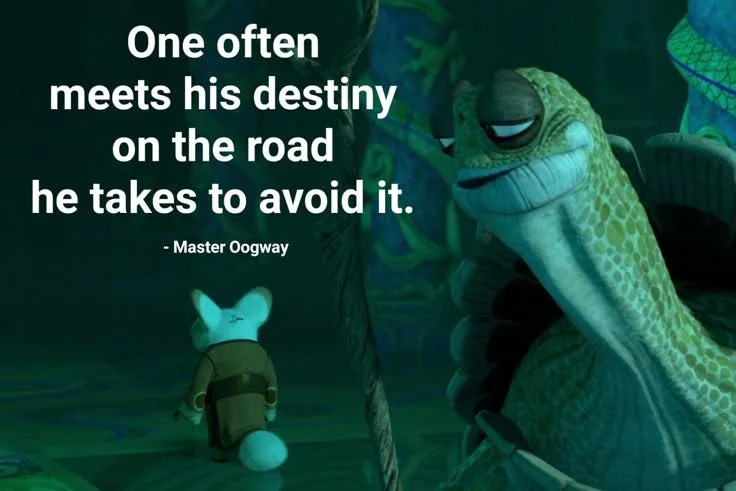
The old stories understood this loop long before we built algorithms. Oedipus meets his fate precisely by running from it. Or as Master Oogway puts it (echoing an old French fable), “one often meets his destiny on the road he takes to avoid it.”
Modern systems create the same loops, only now through scores, rankings, and recommendations.
The most powerful oracle may not be the one that sees the future. It may be the one whose words create it.
The future is not obliged to repeat the past
AI models learn largely from what has already happened. They observe patterns in existing data and use those patterns to produce answers. This is their strength. It is also their limit.
The future is not always a continuation of the past. An unusual person succeeds where similar people failed. A new idea works even when the old patterns say it should not. A student changes. A society changes. A person makes one decision that breaks a lifelong pattern.
If we treat the past as destiny, we leave no room for transformation.
And here human life differs from an ordinary prediction problem. We are shaped by our nature, upbringing, habits and circumstances, but we can also become aware of them. Awareness changes behaviour. A person who understands their anger responds differently the next time. A person who recognises an unhealthy pattern can stop repeating it. A prediction about human behaviour can become less accurate the moment the person becomes conscious of the pattern.
That is why no model can fully contain a human being. We are shaped by patterns. We are not only patterns.
What Krishna refused to give Arjuna
This is where I find the Bhagavad Gita startlingly relevant.
At the beginning of the Gita, Arjuna is not simply afraid. He is confused at the deepest level a person can be confused … caught between duties, relationships, and moral claims, unable to see a single path free of suffering. If he fights, people he loves will die. If he refuses, he abandons what he believes is his duty.
What Arjuna wants, in that moment, is exactly what every person standing before an oracle wants. Tell me what to do. Tell me how this ends. Tell me which path will protect me from regret.
And Krishna refuses.
The Gita does not promise that right action will produce a pleasant result. It does not make duty painless. It does not lift the burden of action off Arjuna’s shoulders. Instead, it changes his relationship with action. Its best-known teaching: you have a right to your action, but not to its fruits.
This does not mean results are unimportant. It means they are not fully ours to control. Intention, preparation, effort, conduct … these are ours. Consequences are not.
Notice how completely this inverts the oracle mindset.
The oracle-seeker asks: What will happen? The Gita asks: What is yours to do?
The oracle-seeker asks: Which action will guarantee success? The Gita asks: Can you act rightly without a guarantee?
The oracle promises certainty. The Gita builds steadiness. It does not satisfy our desire to know the future. It teaches us how to act when the future cannot be known … which is, in the end, the only condition we ever act in.
AI can estimate outcomes. It cannot define dharma.
AI can tell us what is likely. It may point out that a certain business has a low probability of success. It may identify risks in a plan. It may show that people in similar situations often regretted a similar decision. All of this is valuable.
But probability is only one input into a decision.
Imagine someone who wants to leave a safe career to work on a social problem they deeply care about. AI can price the risk accurately. It cannot weigh the meaning. It cannot decide whether a safer but empty life is better than a difficult but meaningful one. It cannot decide what this person owes to their family, their society, or themselves.
Those are not prediction questions. They are value questions. They are questions of dharma.
A machine can analyse the situation, show consequences, challenge assumptions, expose blind spots. It cannot carry the moral weight of the decision. The person who acts must still bear the result.
Three questions we keep mixing up
It helps to separate three questions we habitually collapse into one.
The first: What is likely to happen? AI can be genuinely excellent here. It can study evidence, compare patterns, estimate outcomes.
The second: What matters in this situation? This requires human judgement. It depends on relationships, values, context, dignity, fairness, meaning.
The third: What am I responsible for doing? This is the deepest question, and no model can answer it for us … because no model has to live with the consequences.
AI may answer the first question brilliantly. It can help us think through the second. The third always returns to us.
A mirror, not an oracle
The answer is not to reject AI. That would be unrealistic, and unnecessary. AI is an extraordinary tool. It can help us think more clearly, introduce perspectives we had not considered, point out contradictions in our reasoning, prepare us for different outcomes. Sometimes, when our emotions run high, even a calm, simple response helps us see a situation as it is.
But perhaps we should use it as a mirror rather than an oracle. A mirror does not command us. It helps us see.
We can ask: What assumptions am I making? What am I failing to consider? What is the strongest argument against my position? What might happen under different scenarios? What part of this is actually within my control?
These questions use AI to expand our awareness, not to replace our judgement.
There is a world of difference between asking “What should I do?” and asking “Help me see this situation clearly.”
The first can become an act of surrender. The second is an act of reflection.
The hidden question behind every oracle
Looking back, my small astrology application taught me something beyond astrology. It made me think about why people seek systems that can interpret their lives.
We do not only want information. We want reassurance. We want patterns. We want to believe the future is not open and uncertain, but already readable.
AI is the most powerful pattern-finding system we have ever built. It may help us make better decisions. It may reduce suffering. It may reveal risks we would otherwise miss. But its power will also tempt us to grant it more authority than it has earned. The better AI becomes at answering questions, the more careful we must become about the questions we ask it.
Are we seeking information? Are we seeking clarity? Or are we trying to escape the responsibility of choosing?
The future has always fascinated us because the present demands courage. It is easier to ask what will happen than to ask what we should stand for. Easier to seek certainty than to build judgement. Easier to follow an answer than to own an action.
AI can tell us what is probable. It can show us what has happened before, and possibilities we have not seen. But it cannot live our life. It cannot bear our consequences. It cannot perform our dharma.
The danger is not that machines will become oracles.
The danger is that we will begin to kneel before them.
That’s my reflection today!