Ancient → Modern
Rediscovering Rome’s Indian Odyssey
In the heart of ancient civilizations, two grand civilizations, Rome and India, reached across vast distances, captivated by tales and trade.
On this page
- Sangam’s Symphony: The Yavanas Through Tamil Eyes
- Bustling Ports and Trade
- Tales of Affluence and Romance
- Feasts, Wines, and Shared Revelries
- Beyond the Markets: Yavanas in the Heart of Tamil Society
- Rome’s Perception of India: The Realm of Myths and Marvels
- The Luxuries of the East
- India in Roman Art and Literature
- The Legendary Expedition of Dionysus
- Philosophy and Spirituality
- Parallels in the Perception
In the heart of ancient civilizations, two grand civilizations, Rome and India, reached across vast distances, captivated by tales and trade. The undulating waves of the sea, which separated these lands, carried more than just merchant ships. They bore tales, myths, legends, and a shared reverence for each other that resonates to this day.
To the bustling markets of Rome, India was an enigma wrapped in a shroud of fascination. At the same time, through the poetic lens of Sangam literature, the ancient Tamils viewed Romans as enigmatic ‘Yavanas’, merchants from distant shores bearing gold and wine.
This post embarks on a voyage, tracing how these ancient societies viewed each other, crafting narratives that are both a testament to their trade ties and a celebration of their mutual admiration.
Sangam’s Symphony: The Yavanas Through Tamil Eyes
The sun-dappled shores of ancient Tamilakam (present-day Tamil Nadu and Kerala) echoed with stories of seafaring merchants known as the Yavanas. These tales, immortalized in the timeless verses of Sangam literature, offer a rich glimpse into the Tamil perception of these foreign traders, often believed to be the Romans.
Bustling Ports and Trade
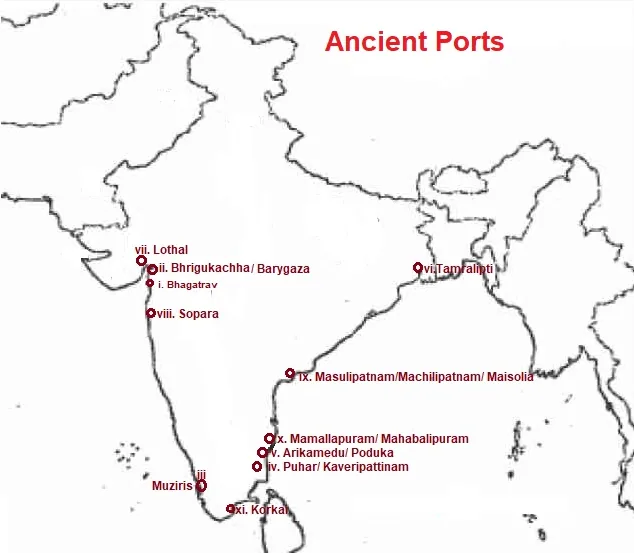
The vivid imagery of the Sangam verses paints a bustling tableau of Tamil ports like Muziris (Mucciri) and Korkai. The poem “Akananuru” resonates with the vibrant sounds of these harbors, where Yavana traders exchanged their fine wines and olive oil for the prized pepper, malabathrum, and gleaming gemstones of the Indian land.
Their presence is further solidified by archaeological findings. Fragments of Roman amphorae, found at Pattanam, believed to be ancient Muziris, stand as silent witnesses to these trade ties.
Tales of Affluence and Romance
But Sangam literature delves deeper than just commercial exchanges. Its verses narrate captivating tales of love and opulence. A particularly evocative depiction presents a Yavana princess, her beauty accentuated by fine muslin from the Ganges, pining for her lover, a Tamil prince. Such tales hint at interpersonal bonds, perhaps marriages, which seamlessly blended the Yavanas into the local fabric of Tamil society.
Feasts, Wines, and Shared Revelries
The “Puranaanooru” offers tantalizing descriptions of lavish Tamil feasts, where wine, a gift from the Yavanas, flowed freely, filling gold cups studded with radiant gems. Such depictions not only hint at the prosperity brought by trade with the Romans but also showcase a shared joy of life’s finer pleasures.
Beyond the Markets: Yavanas in the Heart of Tamil Society
Sangam poets’ keen observations present the Yavanas as distinctive in their appearance and attire, often characterized by their flowing beards and togas. They were subjects of both admiration and curiosity. Beyond the ports and markets, some ventured inland, adopting Tamil customs, and even spiritual beliefs. The post-Sangam text “Manimekalai” speaks of a Yavana king’s conversion to Buddhism, exemplifying the fluidity of cultural exchanges.
This was an age where cultures didn’t just meet but mingled. The Romans, through the Tamil eyes, were not just distant traders. They were part of stories, feasts, and memories.
Rome’s Perception of India: The Realm of Myths and Marvels
The Luxuries of the East
When Romans envisioned India, they conjured up images of a distant land filled with endless wonders. Through the ancient trade routes, such as the Silk Road and maritime passageways, luxury goods like spices, silk, and gemstones entered the Roman markets, eliciting awe and admiration.
Pliny the Elder, in his work “Natural History”, speaks with a mix of astonishment and envy about the vast amounts of gold that Rome sent to India in exchange for her luxury goods. This demonstrates the perceived value of Indian commodities and the wealth of the Indian subcontinent in the Roman imagination.
There are accounts that at the height of the Roman trade with India, around 120 ships set sail every year from Myos Hormos, a Roman port on the Red Sea, to the Indian subcontinent. This information comes from the Periplus of the Erythraean Sea, an ancient Greek travelogue that details the maritime trade routes. It mentions that these ships would return laden with precious goods such as spices, textiles, gems, and much more.
India in Roman Art and Literature
India wasn’t just a trade partner for the Romans; it was a realm of myths. Roman frescoes often depicted Indians as men with beards and turbans, riding elephants or camels, signifying their association with exotic lands and beasts. The Colosseum occasionally showcased animals like tigers and elephants, believed to be from India, during their gladiatorial spectacles.
Literature, too, was not bereft of Indian tales. Roman writers and poets, including Horace and Juvenal, mentioned India, albeit sometimes with stereotypical depictions of its perceived vastness, wealth, and exotic nature.
The Legendary Expedition of Dionysus
According to Greek (later Roman) myth, Dionysus, the god of wine, embarked on an expedition to India. The journey was not easy, as he and his army had to confront giant mountains and fierce river torrents. However, under his guidance, his followers introduced the art of winemaking to India. While there’s no hard historical evidence of such an expedition, this story symbolizes the cultural and commercial ties that had existed between the two regions.
What’s fascinating is how the Romans celebrated this story in their daily lives. Visit a Roman burial site, and you might discover intricate sarcophagi depicting scenes from Dionysus’s adventure. These aren’t just any images; they’re symbols of the deep allure and mysticism India held for the Romans.
Philosophy and Spirituality
While India was a source of luxury and wonder, it was also a land of deep philosophy and spirituality for the Romans. The tales of wise Indian sages reached the Roman elite. Philostratus’ “Life of Apollonius of Tyana” narrates the journey of a philosopher to India, where he engages with Indian ascetics and learns profound wisdom.
Similarly, the spread of Buddhism to Alexandria through the Greco-Buddhist cultural synthesis showcases the intermingling of Indian and Roman spiritual thoughts.
Parallels in the Perception
Both the Sangam literature and Roman accounts signify a mutual respect and fascination. They see each other not as the “other”, but as part of a shared world of wonder, exploration, and understanding. The Yavanas in Sangam poems and the “bearded Indians” in Roman frescoes represent a shared human tendency to romanticize the distant and the unknown.
The confluence of Rome and India wasn’t just about trade routes or commercial exchanges. It was an intersection of two worlds, where myths were born, tales were woven, and identities were reshaped. This ancient dance of mutual admiration stands as a testament to the power of cross-cultural exchanges, reminding us that even in antiquity, our world was interwoven in threads of shared stories and mutual respect.
In the canvas of history, the portrait of Rome and India paints a picture of interconnected destinies, where the scent of Indian spices wafted through Roman markets, and tales of Roman wines found their way into Sangam verses. It is a narrative of love, longing, and lore that still beckons the modern world to look back and marvel.
That’s my learning for today!