Ancient → Modern
The Immersive Odyssey: Vedic Rituals to Virtual Reality
A Vedic yajna was a world you stepped into with every sense, and it had words for the way in and the way out. Our headsets have mastered the first. We may have forgotten the second.
On this page
The Rigveda begins with a fire.
अग्निमीळे पुरोहितं यज्ञस्य देवमृत्विजम्।
होतारं रत्नधातमम्॥
I praise Agni, the one placed in front, the god of the sacrifice, its priest, the one who calls, the richest giver of treasure.
Rigveda 1.1.1
The very first word is agnim: fire. Not an idea, not a god in the sky, but a flame on the ground that you can see and hear and feel on your face. Everything else in the Veda grows out of what happens around that flame: the yajna.
We usually picture a yajna as something to watch: priests, smoke, chanting. But for the person at its centre, it was something closer to what we now call virtual reality. A world you stepped into, with every sense, for a while. And the part I find most remarkable is not how it drew people in. It is that it knew how to let them out.
A world spread out of fire
Stand near a yajna even today and notice what happens to you. The crackle of ghee hitting the flame. The rise and fall of the chant, in a metre you cannot quite follow but somehow feel. The smell of wood and herbs. The heat on your skin. The ground itself marked out with care, so that you know exactly where you are standing. Nothing is left over for the ordinary world.
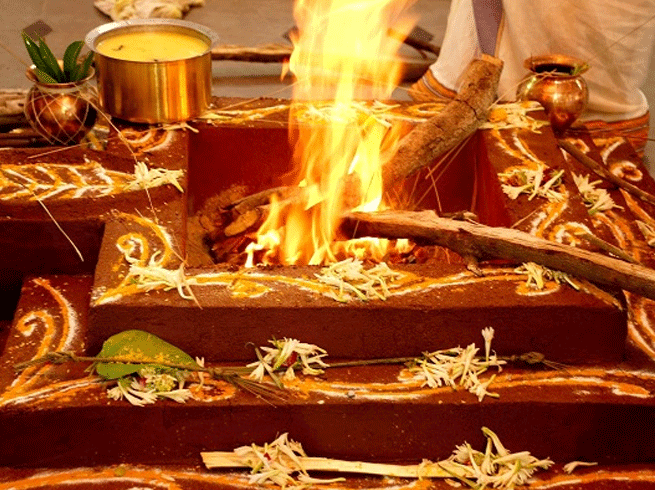
The rishis did not think of this as a show. They thought of it as a small copy of the world itself. The Purusha Sukta imagines the very first yajna, performed by the gods, and the whole year is inside it:
यत्पुरुषेण हविषा देवा यज्ञमतन्वत।
वसन्तो अस्यासीदाज्यं ग्रीष्म इध्मः शरद्धविः॥
When the gods spread out the sacrifice, with Purusha as the offering, spring was its melted butter, summer its firewood, autumn its oblation.
Rigveda 10.90.6
Atanvata: they spread it out, the way a weaver stretches threads on a loom. A yajna was woven. Its ground, its fire, its words were the threads, and what they made was a whole world, the seasons and all, laid out in a few square metres. To stand inside it was to stand, for a few hours, inside the order of the cosmos.
That is what a game designer would call a world. And it was built, like the best of them, to be entered.
From untruth to truth
You did not just walk in. The person for whom the yajna was performed, the yajamana, first took a vow, and the vow came with words. The Shatapatha Brahmana gives them, and explains them:
द्वयं वा इदं न तृतीयमस्ति सत्यं चैवानृतं च।
सत्यमेव देवा अनृतं मनुष्या इदमहमनृतात्सत्यमुपैमीति तन्मनुष्येभ्यो देवानुपैति॥
There are two things, and no third: truth and untruth. The gods are truth, and humans are untruth. When he says, “Now I go from untruth to truth,” he passes from among humans to the gods.
Shatapatha Brahmana 1.1.1.4
Think about what that means. For the length of the rite, he is not quite himself. The text says he becomes, as it were, not human. In the longer rites he was kept apart before the yajna began, fasting, speaking little, wrapped up and sitting with closed fists, and the priests said plainly what they were doing: making him into an unborn child again, so that he could be born into the world of the ritual.
That is immersion in its fullest sense. Not seeing another world from outside, but becoming someone who belongs to it. Today we would call it an avatar.
Now I am who I really am
And then the rite ends, and here the Brahmana does something I have never seen a headset do. It gives him words to come back.
He cannot say, “Now I go from truth to untruth.” That would not be fitting. So he lays down the vow with another sentence:
इदमहं य एवास्मि सोऽस्मि॥
Now I am the one I really am.
Shatapatha Brahmana 1.1.1.6
I love this line. The world of the gods was not a place to stay. It was a place to visit, fully, and return from. The way in had a door, and the way out had a door too, and both were named. And the person who walked back out was meant to be more himself, not less.
The same longing, in every age
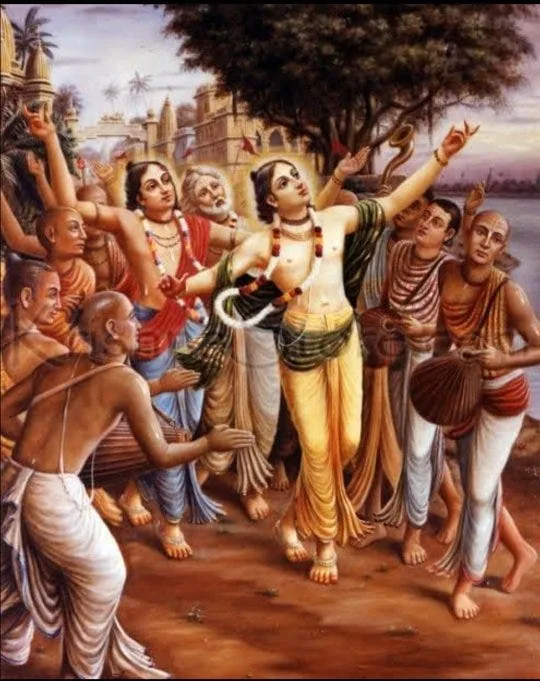
Humans have never stopped building worlds to step into. Five hundred years ago in Bengal, Chaitanya led crowds through the streets singing the names of Krishna, until the whole town seemed to become a temple, and people who had come only to watch found themselves dancing.
A little over a century ago, it was a darkened hall and a beam of light. Strangers sat together and for an hour or two forgot where they were, carried to places they had only dreamt of.
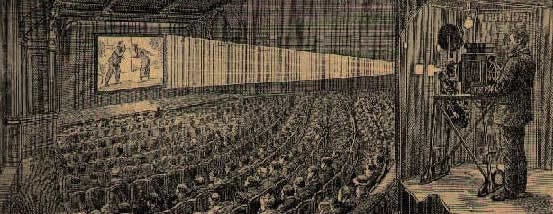
Even the cinema kept a small threshold. The lights went down, and the lights came up. Everyone blinked, stood, stepped back out into the street. Not a vow, but a door all the same.
A headset has no closing words
Now we have the headset. Put it on, and you are not watching a story, you are standing in it. Turn your head, and the world turns with you. Reach out, and something reaches back. People from opposite ends of the earth can stand in the same virtual room, much as a village once gathered around a single fire.

In one sense we have finally built what the rishis were reaching for: a world that takes every sense. But I think we have mastered the door in and quietly lost the door out. Many of our digital worlds, the headset and the endless feed alike, are designed so that there is no last moment, no lights coming up, no point at which you say, “Now I am the one I really am.” You do not leave them. You just eventually stop.
The yajna understood something we are only beginning to relearn. Immersion is not the problem. Going fully into another world, with all of yourself, can be one of the most human things we do. What matters is why you go in, and whether you know how to come back.
And that part, at least, is still up to us. The rite’s closing words are short enough for anyone to keep. The next time you take off the headset, or close the app at the end of a long evening, pause for a moment before reaching for the next thing. Notice the room. Notice your own hands. Idam aham ya evasmi so ‘smi. Now I am the one I really am.
The fire was never meant to keep us. It was meant to send us home a little more ourselves.
That’s my musing for the day.