Indian Thought
The Rise of Vishnu and Fall of Indra
Religion and nature were deeply intertwined in ancient India, with gods representing powerful forces influencing daily life.
On this page
Religion and nature were deeply intertwined in ancient India, with gods representing powerful forces influencing daily life. This blog explores an intriguing perspective: how drying the Saraswati River and subsequent monsoon failure may have led to a significant shift in religious beliefs, from the storm god Indra to Vishnu, the protector. While I’m no historian and can’t conclude that this is exactly what happened, it’s a possibility worth considering. The idea for this blog was inspired by a video on Yajnadevam’s YouTube channel, which explores the connections between climate change and cultural shifts in ancient India. Whether this theory is accurate or not, only time and further research will tell, but it’s fascinating enough to take a closer look.
Two Major Blows to the Indus Valley Civilization
Around 4,500 years ago, the Indus Valley Civilization thrived, supported by the Indus and Saraswati rivers, which flowed through modern-day India and Pakistan. Most of the settlements were on the banks of these rivers. However, geological research suggests that tectonic shifts gradually altered the course of the Saraswati River, causing it to dry up. The drying of the Saraswati was likely a devastating blow to communities that relied on it for agriculture, trade, and daily life. As the river receded, people would have faced practical challenges and a loss of security, forcing some to migrate or adapt to increasingly arid conditions.
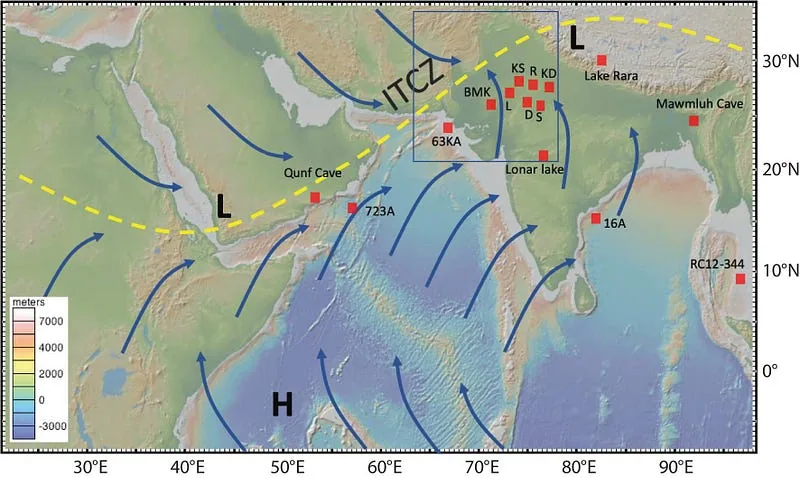
But this wasn’t the only hardship these communities faced. Researchers like Yama Dixit, in studies such as “The Indian Summer Monsoon from Speleothems” and “Paleolakes in Northwestern India,” discovered that around 4,200 years ago, the Indian Summer Monsoon (ISM) also began to weaken and shift eastward. This change redirected seasonal rains away from the Indus Valley, intensifying the drought conditions in the region. Studies published in Communications Earth & Environment (2023) have shown that these drought spells could last anywhere from 25 to 90 years at a time, with a cumulative dry spell persisting for over two centuries.
For the people of the Indus Valley, this combination of the Saraswati’s disappearance and weakening monsoon rains would have been catastrophic, stripping away two critical water sources. As crops failed and rivers receded, these dual challenges likely forced many communities to migrate eastward in search of reliable water and more fertile lands. This displacement set the stage for a shift in culture and, potentially, religion.
When the Storm God Lost His Power
In the Rigveda, Indra is celebrated as the powerful god of storms, rain, and thunder. He was revered as the hero who brought rains by defeating Vritra, the demon who held back the waters. For an agrarian society, Indra’s control over the rains was essential, making him one of the most vital gods in the early Vedic period.
But with each failed monsoon, people may have started to question Indra’s power. After all, Indra was the rain-bringer, yet the rains they relied on became increasingly unreliable. As drought continued year after year, the faith in Indra’s power may have started to wane. Why continue worshipping a god who seemingly failed to deliver the life-giving rains when they were needed most? This “failure” could have led to a gradual loss of faith in Indra, making room for other gods and beliefs that resonated more with the society’s changing needs.
Migration East and the Rise of Vishnu
Facing a prolonged drought and the loss of the Saraswati River, many people began to migrate eastward, away from the drying lands of the Indus Valley, to the fertile east indian plains. But this move wasn’t just a physical relocation; it also transformed their culture and religious outlook. In their new homeland, people no longer needed a warrior god associated with storms and rain but rather a protector who symbolized stability, peace, and cosmic order.
This is where Vishnu, initially a minor figure in the Rigveda, began to rise in prominence. Unlike Indra, Vishnu wasn’t associated with the capricious forces of nature. Instead, he symbolized preservation, cosmic balance, and order, qualities that may have been comforting to a society recovering from years of environmental upheaval. Vishnu’s “three strides” across the universe, symbolizing his encompassing presence, became especially meaningful to a population looking for continuity and stability in the wake of two major natural disasters.
From Natural Forces to Moral and Social Order
As these communities settled into the Gangetic plains and other parts of India, the qualities they valued in a deity began to shift. Where Indra once represented nature’s raw power, Vishnu started to embody the principle of Dharma, or cosmic order, aligning with the values of a society that now prioritized stability and harmony over the chaos of natural elements. This transition also reflected a move from survival-focused worship to a worldview that embraced social order and moral authority.
In this way, Vishnu’s role as a preserver of Dharma resonated deeply with people who were weary of nature’s unpredictability. Rather than a god tied solely to physical forces, Vishnu represented a broader, moral authority: an ideal figure for a society seeking peace after a period of instability and displacement.
Adapting Gods for Changing Times
The story of Vishnu’s rise and Indra’s decline reveals how deeply environmental realities shape human beliefs and cultures. As ancient India grappled with the dual shocks of the Saraswati River’s drying and failing monsoon rains, its people responded not only by adapting where they lived but also by transforming how they viewed the divine. Their journey from revering a storm god to embracing a god of protection and order reflects an enduring human trait: the ability to reshape beliefs in response to changing needs.
In today’s world, we are facing our own environmental challenges, from climate change to resource scarcity. Like the ancient people of the Indus Valley, we too are being asked to adapt. The shifts in Indian spirituality from gods of natural power to deities of stability and moral order remind us that crises, however destabilizing, can inspire us to reimagine our values and priorities. Just as they sought new sources of meaning amid droughts and migrations, we too might consider what kind of world we want to create and what principles we want to uphold.
This ancient story isn’t just about two gods: it’s a reflection of humanity’s resilience and adaptability. It teaches us that even in the face of seemingly insurmountable challenges, we have the power to reinvent ourselves and our beliefs. In adapting our values, we’re reminded that faith, culture, and society are not static but ever-evolving, shaped as much by the natural world as by our own aspirations. Perhaps, like the people who looked to Vishnu as a symbol of order and preservation, we too can find ways to respond to modern challenges with a renewed commitment to balance, compassion, and resilience.
That’s my learning for today!