Indian Thought
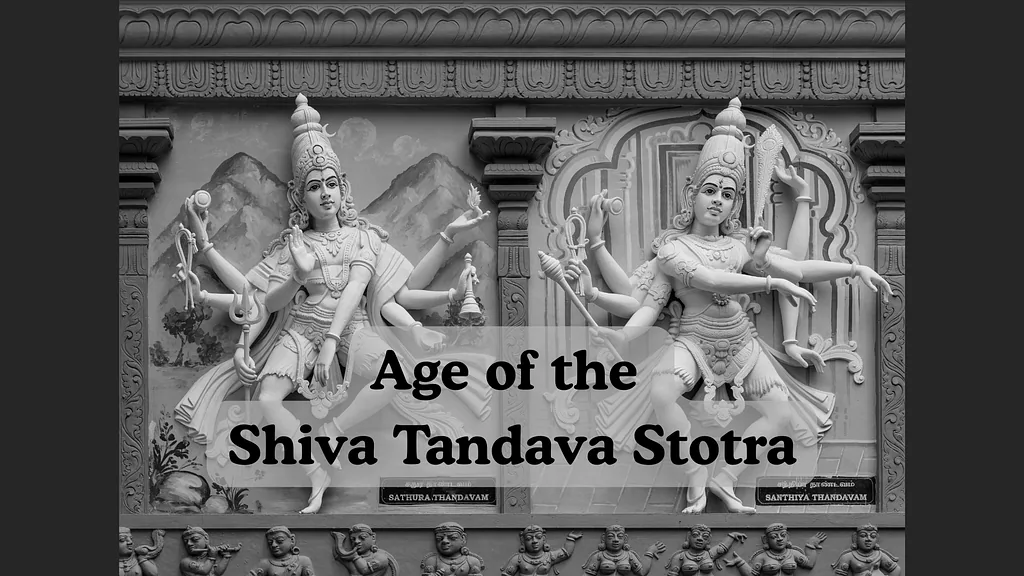
Age of the Shiva Tandava Stotra
The hymn is credited to Ravana, but its metre, vocabulary and imagery point somewhere else entirely: eighth-century Rashtrakuta India.
On this page
Few Sanskrit hymns match the vitality of the Shiva Tandava Stotra. It is not quiet devotion but a surge of rhythm and imagery: hair swirling with the Ganga, serpents coiling as ornaments, the third eye flashing like lightning. Each verse beats like a drum.
“Jhaṭāṭavī-galaj-jala-pravāha-pāvita-sthale / Gale’valambya lambitāṃ bhujaṅga-tuṅga-mālikām…” - Shiva Tandava Stotra
This hymn has been recited for centuries, often introduced as the song sung by Ravana himself to praise the Lord of Dance. But if we look beyond the legend, there lies a historical question:
When and where did this Sanskrit poem actually take form?
That question has fascinated scholars for decades. Among them, the art historian V. S. Agrawala offered a bold idea: that the Shiva Tandava Stotra belongs not to mythic antiquity but to the Rashtrakuta period, around the 8th century CE. He saw a deep link between the words of the hymn and the sculptures of Ellora’s Kailasa temple, where Shiva’s dance comes alive in stone.
His hypothesis shifted attention from mythic origins to cultural context: seeing the hymn not as an ancient relic from the Epics, but as a product of the same creative energy that shaped early medieval India’s great Shaiva monuments.
Our continuation of that line of thought
The present study builds on Agrawala’s foundation but adds new layers of evidence. Using modern textual databases, metrical analysis, and a more complete survey of Ellora’s iconography, it asks three simple, concrete questions:
- How does the rhythm of the hymn compare to other Sanskrit verse forms of known date?
- What does its language tell us about its literary age?
- Where in Indian art do its images first appear together? All three lead toward the same century, roughly 750 to 850 CE, and the same artistic center: the Kailasa Temple at Ellora.
1. The rhythm that moves like fire
The Shiva Tandava Stotra begins not with a prayer, but with motion.
“…ḍamaḍḍama ḍamaḍḍama nināda vaḍḍamarvayaṃ / chakāra chaṇḍa tāṇḍavaṃ tanotu naḥ śivaḥ śivam”. , v. 1
That repeating damaddama is not decorative. It mimics the double-beat of the damaru drum. Each quarter-line holds roughly sixteen syllables, dominated by heavy beats and consonant clusters that pull the reciter forward.
Scholars of Sanskrit prosody note that this pattern - sometimes classed as a variant of the Sikharini metre, belongs to the late Classical period, around the 6th–8th centuries CE. The Rigvedic hymns were freer, the epics used looser sloka metres, and later bhakti compositions shifted toward lighter rhythms. The Tandava’s structure sits squarely in the middle: disciplined, musical, and theatrical.
In performance, it sounds less like recitation and more like choreography, exactly what its title suggests: Tandava, the dance of Shiva himself.
By tracing the metre’s evolution and comparing it with dated compositions of Kalidasa (5th century) and Sankara (8th century), we find the Shiva Tandava Stotra shares features with that transitional moment, when Sanskrit poetry became both temple art and stage art.
2. The language that paints movement
If rhythm is the heartbeat of the Shiva Tandava Stotra, language is its body. Every line turns an abstract idea, power, balance, devotion, into a visual act.
Consider a few examples:
- “Karāla-bhāla-paṭṭikā-dhagad-dhagad-dhagaj-jvalat…” … “His broad forehead blazes, flaring with fire”. The repeating dhagadhaga syllables don’t just describe fire; they sound like it.
- “Jaṭā-kaṭāha-sambhrama-bhraman-nilimpa-nirjharī…” … “His matted hair whirls, spinning the celestial streams. You can almost see water flying from the locks. Such imagery shows how the poet thought in cinematic motion. Each verse begins with kinetic verbs, rushing, blazing, shaking, and ends in stillness or radiance. The poem is, in essence, a moving sculpture in words.
Grammatically too, the Sanskrit belongs to a period when long compounds (samasa) had become a signature of ornate kavya poetry, but before later ritualist vocabulary crowded devotional literature. We find bhujaṅga (serpent), tripura (three cities), ganga, rudra, all classical, all mythic, but none yet layered with the scholastic terminology of Shaiva Siddhanta that appears in Tamil Nadu texts from the 10th century onward.
That places the poet in the early-medieval Sanskrit world, a few centuries after Kalidasa but before the flowering of regional bhakti movements, a time when Sanskrit still served as the shared language of devotion, theatre, and royal praise.
3. The temple where the hymn lives
Dr V. S. Agrawala was the first to notice that the Shiva Tandava Stotra does not merely describe myth; it mirrors an actual temple program.
At Ellora, near modern Aurangabad in Maharashtra, the **Kailasa Temple **rises from the rock like a mountain sculpted from within. Archaeologists date its main phase to around 756-773 CE, during the reign of Krishna I of the Rashtrakuta dynasty. Later rulers extended and decorated it, but the core structure belongs to that period.
Now look at what the temple shows:
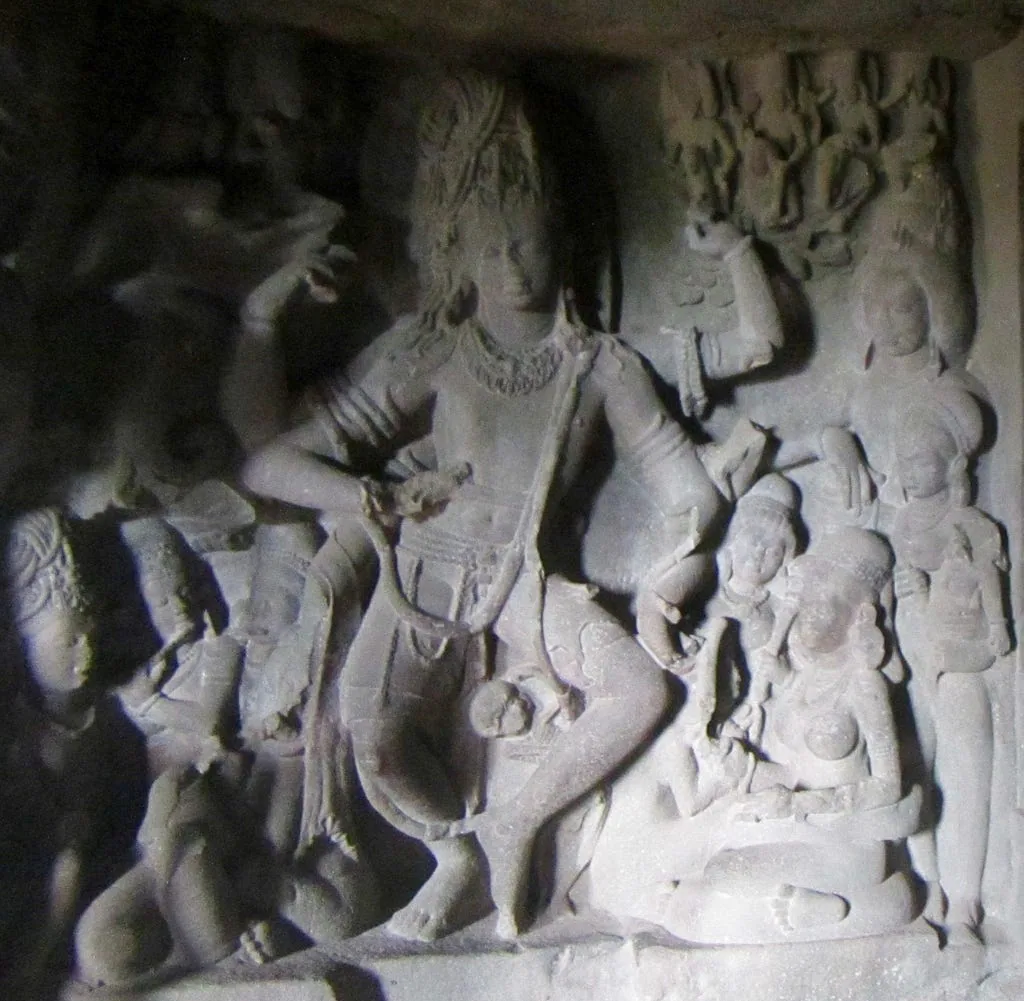
- Gangadhara Shiva: the descent of the river Ganga from his hair, carved on a side wall.
- Tripurantaka: Shiva aiming his flaming arrow at the three demon-cities, depicted in dynamic motion.
- Andhakasura-vadha: Shiva slaying the demon Andhaka.
- Gajasura samhara: dancing upon the elephant demon’s hide.
- Nataraja Shiva: the cosmic dancer.
- Ravana shaking Mount Kailasa: carved prominently inside the temple’s hall, the very legend that tradition links with the stotra’s origin.
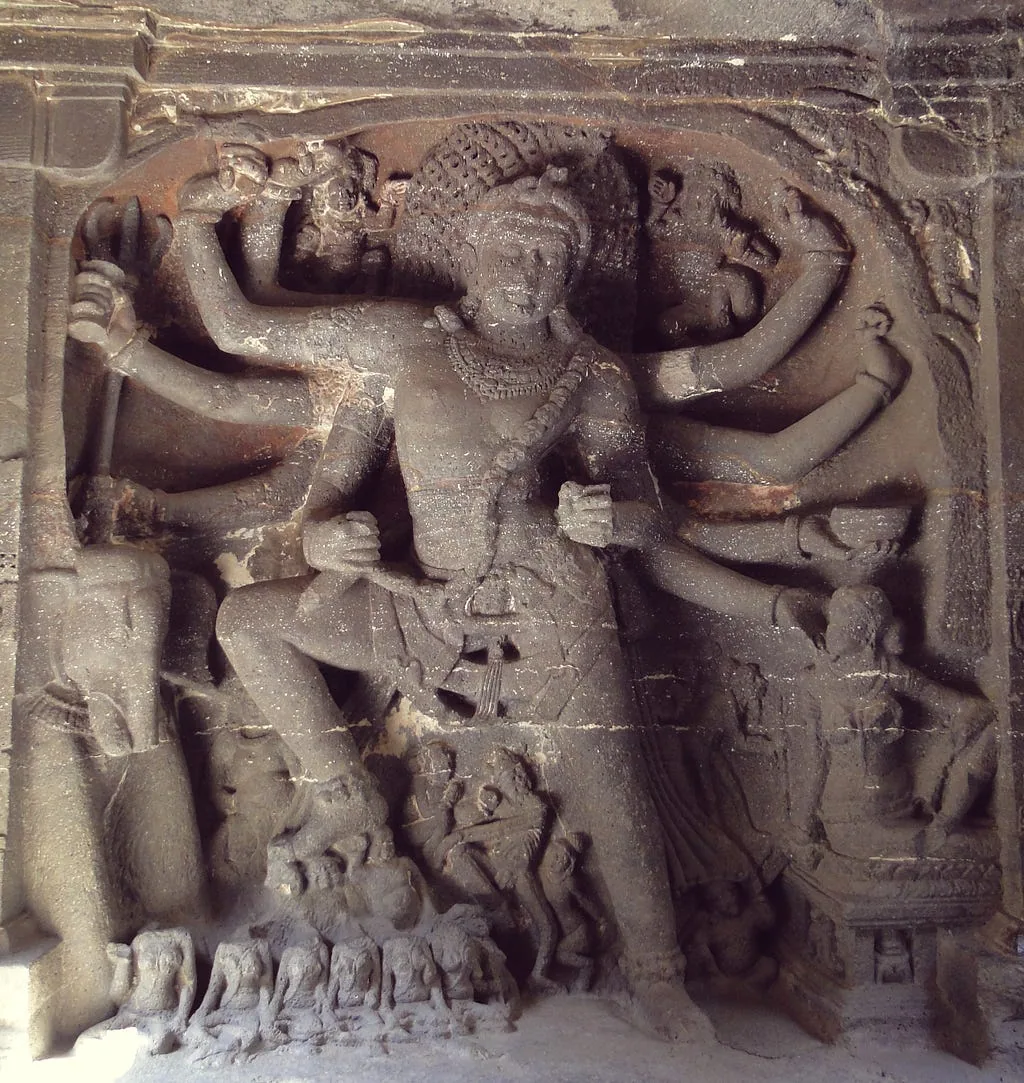
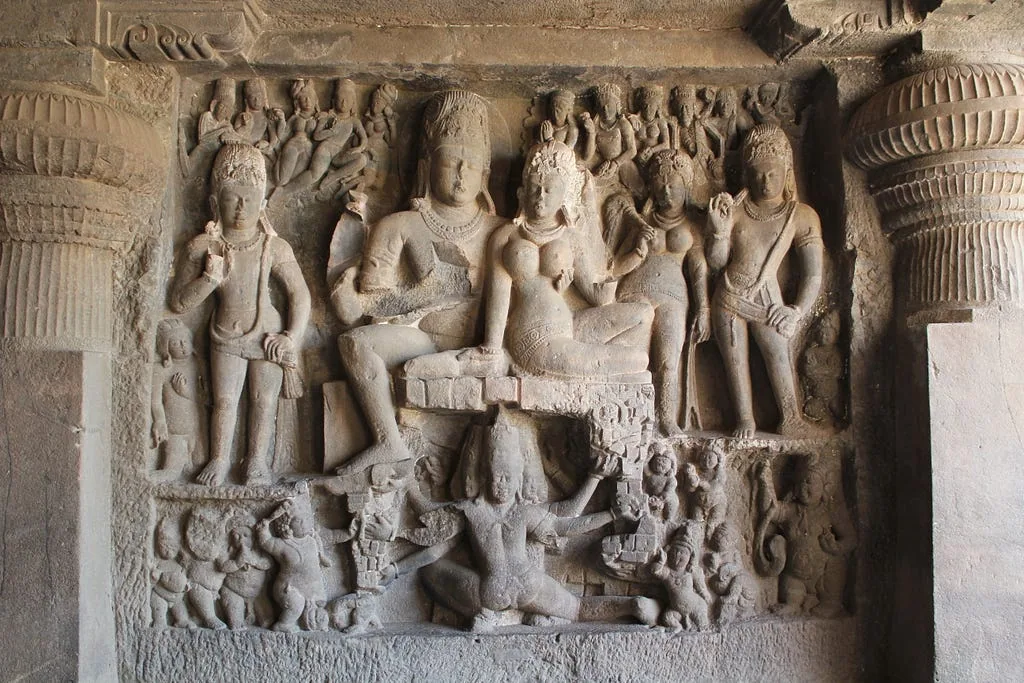
Each of these scenes appears in the hymn. The sculptors at Ellora captured in stone the same vision the poet gave in sound.
While earlier sites like Elephanta Cave (6th century) already show Gangadhara and Nataraja panels, and later Chola bronzes (10th–12th centuries) perfected the image of Shiva’s dance, it is only at Kailasa that we find this entire ensemble together. That convergence is what led Agrawala to see the stotra and the temple as products of one creative horizon: the 8th-century Rashtrakuta age, when poetry, sculpture, and ritual reached perfect balance.
Putting the Clues Together
- Sound → metre : A sophisticated 16-syllable-per-quarter style suggests late Classical Sanskrit .
- Language → vocabulary & imagery : Poetic, visual, devotional: but without later ritual overload.
- Image → sculpture : A match in relief to the hymn’s scenes, precisely in the Ellora setting of the late 8th century. All three converge to give a strong hypothesis: the Shiva Tandava Stotra, as we have it, likely took its current form around 750: 850 CE, in the Western Deccan region under Rashtrakuta patronage.
I feel Shiva Tandava Stotra and the Kailāsa Temple tell the same story in different media: one carved, one chanted.
The conclusion is cautious but consistent: the Shiva Tandava Stotra of Ravana most plausibly belongs to the 8th century CE, reflecting the same artistic world that produced the Kailasa Temple.
That is my learning for today!
After tracing its rhythm in verse and in stone, it feels right to return to the sound itself.
Reading about the Shiva Tandava Stotra is one thing, but hearing it chanted, feeling the pulse that has echoed for more than twelve centuries, completes the experience.
Here’s my favorite rendition:

About this study
This article builds on Dr V. S. Agrawala’s original essay “Shiva Tandava Stotra of Ravana” and re-examines his thesis through a broader lens:
- Textual analysis : metre count and linguistic comparison with dated Sanskrit works of Kalidasa (5th century), Bharavi (6th century), and Aadi Sankara (8th century).
- Iconographic correlation : verification of Kailasa Temple reliefs (Tripurantaka, Andhakasura-vadha, Gajasura samhara, Nataraja, Gangadhara) documented by the Archaeological Survey of India and UNESCO.
- Historical framing : alignment with Rashtrakuta period chronology ( Krishna I , 756–773 CE) and stylistic features shared with contemporaneous Deccan art.