Indian Thought
The Many Faces of Indian Gods: A Historical Story
In the Rigveda the gods have no faces, only fire, storm and wind. How Indian divinity travelled from poetic metaphor into carved, worshipable stone.
On this page
Vedic Beginnings
When we step into the earliest layers of Indian religious imagination, the Rigveda, composed around 1500 BCE (or may be older), the gods look very different from what later temples show us. They are not sculpted forms yet; they are powers, elements, and forces of nature clothed in poetry.
Agni is fire, visible and tangible in the sacrificial flame. Indra is the storm, strong and thunder armed, the one who frees the waters by slaying Vritra. Vaayu is the rushing wind. Varuna is the cosmic law, the wide stretching expanse of the waters. These gods have bodies in the hymns; Indra has arms, Agni has a mouth, Soma is pressed and drunk, but their physicality is fluid, metaphorical, not fixed in stone.
They are called “many eyed”, “golden handed”, or “thousand horned”, but these are poetic epithets, not prescriptions for idols. The Vedic seers did not carve statues; they invoked powers through sound, fire, and ritual.
In this world, the idea of a god with multiple faces is absent in the literal sense. What we find instead is the language of infinity.
The First Glimpses of Many Heads
The **Rigveda’s **Purusa Sukta offers one of the earliest such visions: the cosmic person (purusha) is described as having a thousand heads, a thousand eyes, a thousand feet. This “thousand” is not arithmetic; it is an ancient way of saying “countless”. The hymn is not about a specific deity with sculpted faces but about totality, omnipresence, the being from whom the cosmos is born.
Elsewhere, hymns gesture toward the same imagination. The Asyāvāmīya, a Riddle Hymn (Rigveda 1.164), describes a mysterious reality featuring seven horses, seven mouths, and cryptic wheels of time. These are riddles of the cosmos, images for the sacrificial fire, the year, the sun, and the hidden speech (Vak). They are not descriptions of a god with fixed faces, like we later see with Brahma or Shiva.
These hymns matter because they plant the seed. Divinity can be imagined with more than one head. But in the Vedic age, this remained in the realm of poetry, not sculpture.
The Leap of the Classical Age
Centuries after the Vedas, the Brahmanas and Upanisads begin to shift the language. Gods start acquiring more defined characters. Prajapati emerges as a creator, an early prototype of Brahma. Rudra becomes fiercer, a precursor to Shiva. Vishnu, initially a minor god among the Adityas, grows in stature.
Still, the multifaced motif is not yet tied to these gods. It is in the late Vedic and early post-Vedic layers that we see the first move toward fixed numbers.
Shiva
Shiva has the strongest claim to being India’s earliest multi-faced deity. In the Taittirīya Araṇyaka (10.17–21), part of the Krishna Yajurveda (~800 BCE), we find the panchabrahma mantras. These name five aspects of the deity:
- Sadyojata
- Vamadeva
- Aghora
- Tatpurusa
- Isana Later Shaiva theology would interpret these not merely as aspects, but as five distinct faces of Sadashiva. The idea had moved from “limitless multiplicity” to a structured, enumerated schema.
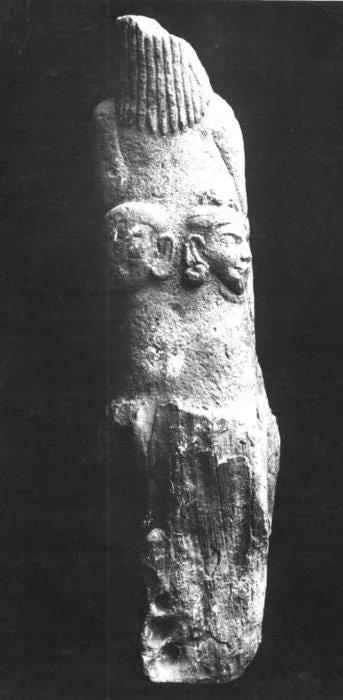
This textual imagination found its first sculptural expression at Bhita, near Prayagraj, where archaeologists unearthed a five-faced mukha-liṅga dated to the late 1st century BCE. For the first time, we can see in stone what the texts had hinted at: the god not with one serene face, but with many, turned to different quarters.
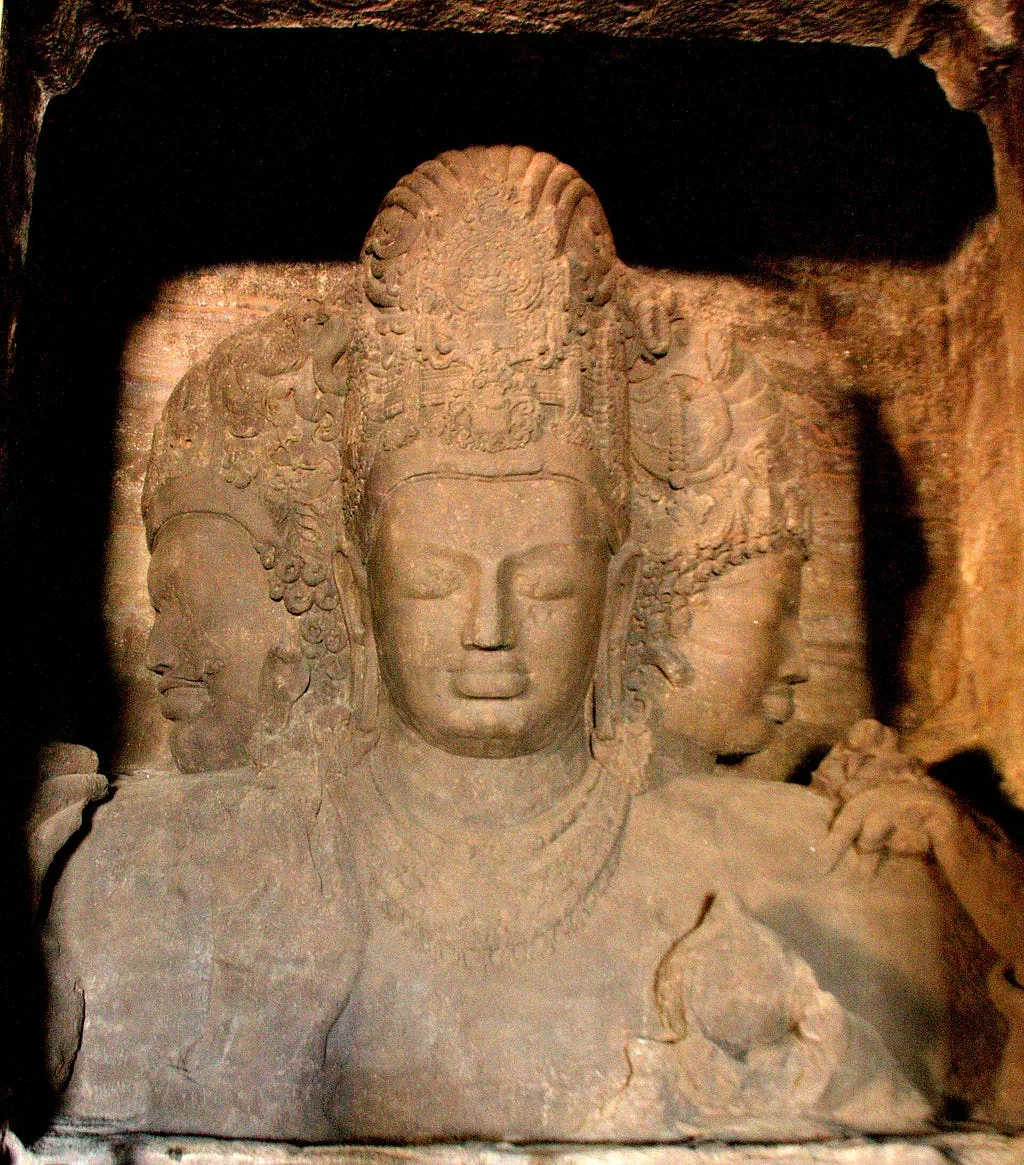
By the mid-6th century CE, this vision was monumentalized in the Elephanta Caves near Mumbai. The colossal three-faced bust of Sada Shiva (serene, fierce, and creative aspects) stands as one of India’s greatest sculptural achievements. With Elephanta, Shiva’s multiplicity was no longer abstract; it became the very face of religious art.
Brahma
Brahma’s story is more complicated. In the Vedas, there is no Brahma as we know him today. Instead, the Prajapati of the Brahmanas embodies creation, sacrifice, and cosmic order. It is only in the epic and Puranic age that Brahma becomes a distinct figure.
The Puranas explain his four faces with myth: once he had five, but one was burned away by Shiva. Yet these stories reflect something else: the iconographic convention already emerging.
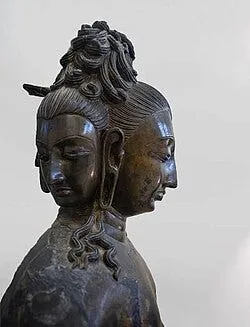
The first depictions of Brahma with four faces come from the Gupta period (5th century CE), especially the Mathura school. Here, Brahma appears as *Chaturmukha, *four faces turned to the four directions, four arms holding ritual implements.
Why four? The symbolism is layered:
- Four Vedas, each face reciting one.
- Four directions, all-encompassing sight.
- Four stages of life and four aims of man, embodying total knowledge. Textual prescriptions reinforce this. The Vishnudharmottara Purana ( 6th, 7th century CE), an encyclopedic treatise on iconography, insists that Brahma must be carved with four faces. The Maanasaara (an architectural text) echoes this.
Thus, Brahma’s four heads are not ancient Vedic truth but a classical codification: a theological and artistic decision made in the Gupta age, then canonized in medieval texts.
Vishnu
Vishnu’s case is unique. The *Bhagavad Gita *(~2nd century BCE), describes Krishna’s vishvaroopa: the universal form with countless faces and eyes blazing across the sky. Arjuna is terrified by this vision of infinity. This is the first explicit textual description of Vishnu with multiple heads, but it is not a fixed number. It is the language of the boundless.
The transition to a standardized four-faced Vishnu came later, through the Pancharatra texts. The Jayakhya Samhita (Gupta era) already hints at a multi-faced Vishnu, and by the 7th century CE, the Vishnudharmottara Purana describes the form we now call Vaikuntha Chaturmurti:
- The human face of Vishnu.
- Varaha (Boar).
- Narasimha (Lion).
- A fierce demonic face, often called Kapila.
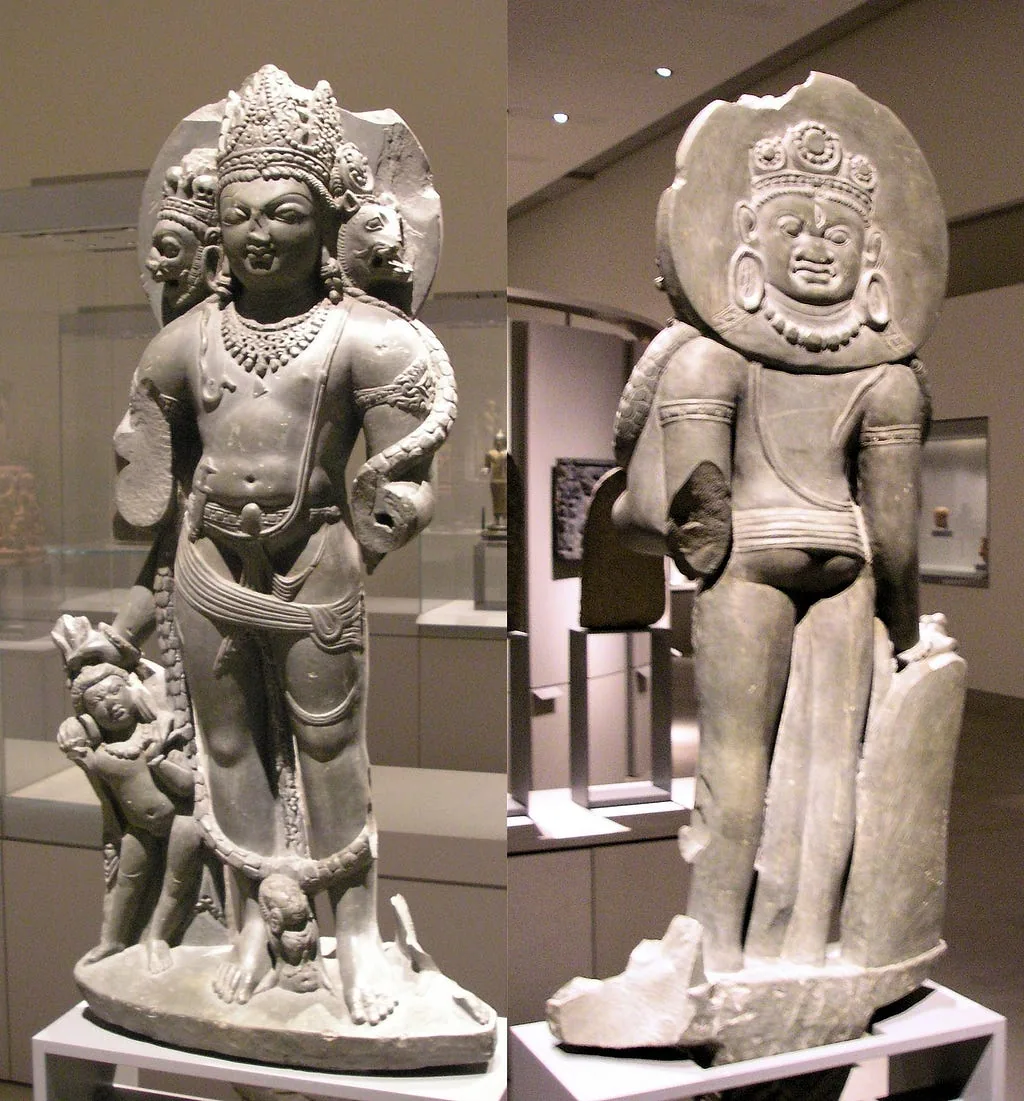
The earliest surviving icons of this form come not from the Gangetic plains but from Kashmir in the late 8th century CE. In Kashmiri temples, Vaikuntha Vishnu became the dominant image, his four faces embodying his manifold avataras and cosmic authority. One such Kashmiri image was later installed at Khajuraho’s Laksmana temple (10th century CE), a reminder of the prestige of this form.
Others Before the Trinity?
If we look strictly at the Vedic texts, the answer is no: no single deity has fixed multiple faces. The Purusha has a thousand heads; the Riddle Hymn speaks in sevens; Agni is “many-tongued” and “all-formed”. But these are metaphors, not icons.
It is only with the rise of the Trinity (Shiva, Brahma, and Vishnu) that multiple faces are tied to specific gods, codified in texts, and fixed in stone. Later, especially in Tantric traditions of the medieval period, goddesses too acquired multiple heads: Gayatri with five faces symbolizing the Vedas, or Durga and Kali in esoteric forms. But these are later developments (10th century CE onward).
Why Multiplicity?
Multiplicity in Indian gods was never arbitrary. Each additional face was a visual metaphor, embedding layers of meaning:
- Cosmological: Four faces align with the four Vedas, four directions, four seasons, four stages of life. Five faces add the vertical axis, the transcendence that rises above the material world. A thousand faces express infinity itself.
- Philosophical: A god with multiple faces symbolizes omniscience . No single human face can see all sides. A four-faced Brahma knows all quarters; a five-faced Shiva encompasses creation, preservation, destruction, concealment, and grace; a thousand-faced Vishnu manifests boundlessness.
- Ritualistic: In Vedic ritual, the sacrificer invokes all quarters, all fires, all hymns. A multi-faced god mirrors this ritual completeness, embodying the wholeness of the sacrifice.
- Political: Kingship in ancient India was often described as “ruling the four directions”. Deities mirrored this royal ideal, projecting divine kingship into cosmic kingship. Multiplicity, in short, was a language of totality.
The gods of the Vedas were elemental: fire, storm, wind, water. They did not yet wear faces of stone. But once multiplicity entered religious art, gods became not just elemental forces but cosmic persons, sculpted to see in every direction, to hold every hymn, to embody every act of creation and destruction.
Shiva with his five faces, Brahma with his four, and Vishnu with his infinite countenance represent not mythic quirks but historical turning points. They mark the moment when Indian religion learned to express infinity; not just in hymns, but in icons, carved for worship, carried across centuries.
The many faces of the gods are, at heart, India’s way of saying that the divine cannot be contained in one view, one name, one form. To see the whole, one must look from every side at once.
That’s my learning today!